Affordable vs Luxury Property in Istanbul: What You Get at Each Budget

In Istanbul, the gap between an affordable and a luxury home is mostly about location: the same size of apartment costs far more on the Bosphorus or in the central business districts than in the newer districts on the western edge of the city. For foreign buyers, two budget lines matter more than any others: USD 200,000, the minimum value for a residence permit through property in Istanbul, and USD 400,000, the minimum for Turkish citizenship by investment.
This guide replaces our 2020 list of five projects. Those projects have since been sold or delivered, and prices have changed completely, so instead of a list we explain what each budget buys and what makes one home cost more than another. For projects currently on sale, see our Istanbul listings.
What Drives the Price Difference
When you compare two apartments in Istanbul, these factors explain most of the gap:
- Location and land. Land in central Istanbul is scarce, so land values, and with them the price per square metre, are highest in the established centres. Newer districts on the outskirts have more land and lower prices.
- Transport. Being within walking distance of a metro or Marmaray station, or the Metrobus line, usually adds to the price. New rail lines tend to lift prices around their stations.
- View. A sea or Bosphorus view is one of the biggest single price factors. Within the same building, sea-view apartments are usually priced higher than those facing the city.
- Building age and earthquake safety. New buildings are designed to the current earthquake code (in force since 1 January 2019); older stock is cheaper but may carry more risk.
- Compound and amenities. Gated compounds with pools, gyms, security and parking cost more to buy and have higher monthly service charges.
- Size and layout. Price is quoted per square metre, so check whether it is gross or net area. Our guide to gross and net square metres explains the difference.
- Developer and specification. Well-known developers, branded residences and high-end finishes add a premium.
- Payment terms. Off-plan projects often offer instalment plans; a lower cash price may be available for full payment. See properties with payment plans.
What Each Budget Buys
The bands below are a general guide, not a price list. Prices change with the market and vary widely within each district, so always compare recent sales in the same project or street.
| Budget | Typical districts | Typical property |
|---|---|---|
| Under USD 200,000 | Western outskirts and outer districts | Studios and one-bedroom apartments, often in large compounds or older buildings |
| USD 200,000–400,000 | Western and northern growth areas, parts of the Asian side | Two- and three-bedroom apartments in new compounds; residence permit possible |
| USD 400,000 and above | Growth areas, city-centre districts, sea-view locations | Family apartments or several units; eligible for citizenship |
| Luxury and prime | Bosphorus, central business districts, prime Asian-side neighbourhoods | Branded residences, large apartments, villas, Bosphorus views |
Under USD 200,000
The lowest prices in Istanbul are found mostly in the western districts that grew quickly over the last two decades, such as Esenyurt, Avcılar, Beylikdüzü and Büyükçekmece. Here you will mainly find studios and one-bedroom apartments.
Two points to keep in mind at this budget:
- A home below USD 200,000 does not qualify for a residence permit through property in Istanbul.
- Some neighbourhoods in these districts are closed to new residence permits for foreigners. If you plan to live in the home, check the current list first. See which districts are open for a residence permit.
USD 200,000 to USD 400,000
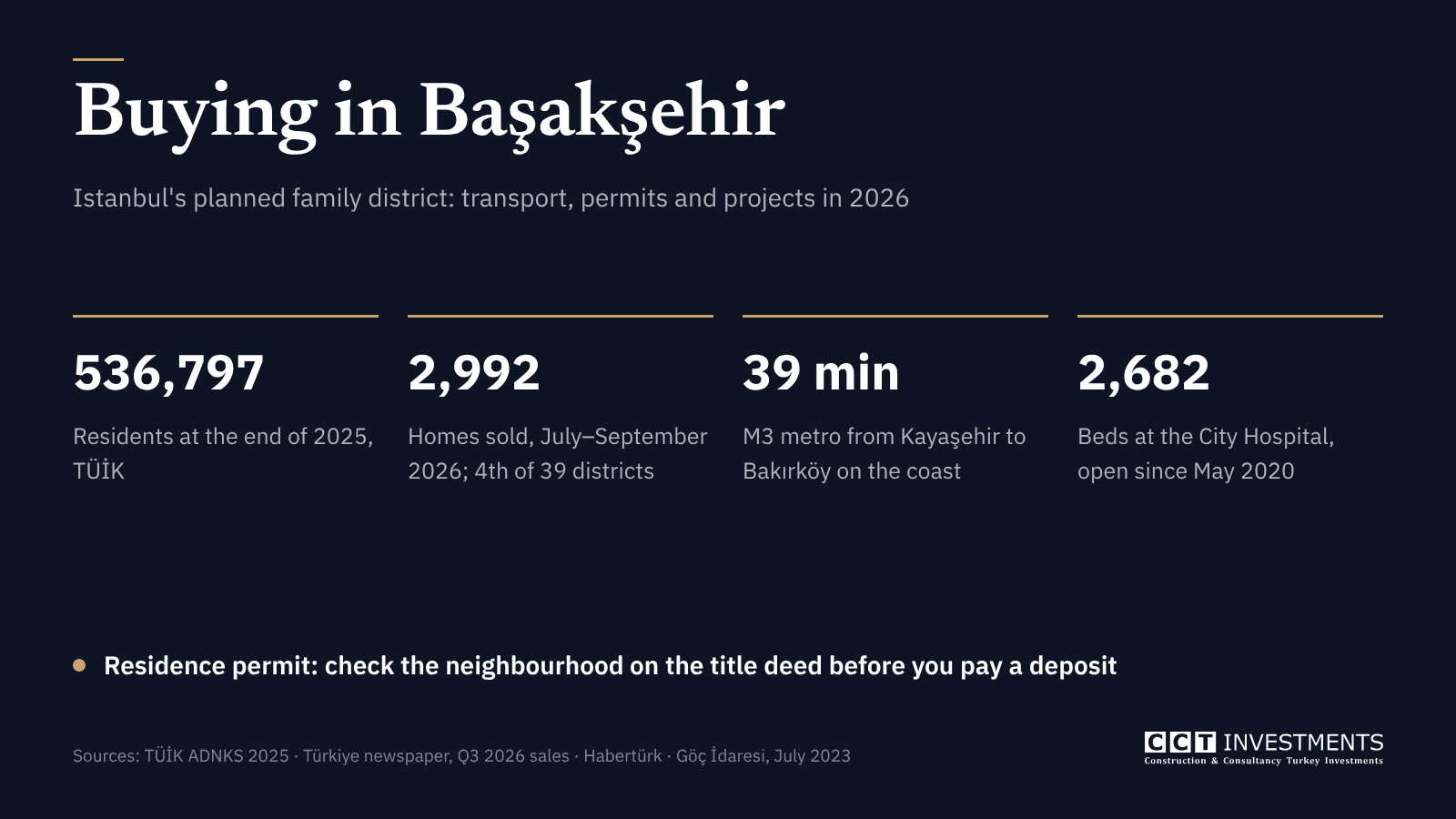
This is the range where most families find a two- or three-bedroom apartment in a new compound, in districts such as Başakşehir, Bahçeşehir, Küçükçekmece, Halkalı, Kağıthane or, on the Asian side, Kartal and Maltepe.
From USD 200,000, a home in Istanbul can support an application for a residence permit. The permit is not automatic: the neighbourhood must be open to new permits, you apply online through e-İkamet, and the application is completed at the Provincial Directorate of Migration Management. You can renew it while you own the property. More in our guide to Turkish residency through property.
USD 400,000 and above: the citizenship line
At USD 400,000, a property purchase can qualify for Turkish citizenship, provided a three-year no-sale annotation is placed on the title deed. Your spouse and children under 18 are included. You can reach the amount with one property or several, and in many districts it buys a large family apartment in a new compound.
Central and sea-view districts such as Zeytinburnu, Bakırköy, Ataköy, Ataşehir and Üsküdar cost more per square metre than the outer districts, so the same budget buys a smaller home there. See our citizenship page for the full process.
Luxury and prime
The top of the market is in the central business districts and along the Bosphorus: Şişli, Bomonti, Maslak, Etiler, Beyoğlu and prime parts of Kadıköy. Here you pay for scarcity: Bosphorus views, walking distance to offices and restaurants, branded residences with hotel-style services, and large villas. Prices per square metre in the best locations are far higher than in the outer districts.
Affordable or Luxury: Which Suits You?
- Living in the home yourself. Put commute, schools and daily needs first. A cheaper home far from your work can cost you hours in traffic every week. Transport links matter more than amenities.
- Renting it out. Lower-priced homes in well-connected districts tend to rent quickly, but rents and yields vary; luxury homes have a smaller pool of tenants. Nothing is guaranteed, so ask for recent rents in the same building.
- Residence or citizenship. Plan around the USD 200,000 and USD 400,000 lines from the start. A residence permit goes by the price on the title deed; for citizenship, the deed price and your transfers must each reach USD 400,000 and be confirmed by a certificate based on a valuation report.
- Long-term value. Across Istanbul, prices have risen in lira but more slowly than inflation: in July 2026 the Central Bank's house price index was 25.0% higher than a year earlier but 5.1% lower in real terms. See house prices in Turkey.
What This Means for Buyers
- Start from your goal, not from the price: home, rental income, residence permit or citizenship each point to a different budget band.
- Compare like with like. Check price per net square metre, the building's age and earthquake design, service charges and the view before comparing two homes.
- Check the thresholds early. A home just under USD 200,000 or USD 400,000, or in a closed neighbourhood, will not support a residence or citizenship application.
- Budget for costs. Add the 4% title deed fee (usually split 2% buyer / 2% seller), VAT on new builds unless you qualify for the VAT exemption, the valuation report if you are buying for citizenship, and furniture. Our buyer guide lists every cost.
CCT Investments has been helping international buyers in Istanbul since 2014. Buyers pay no commission on new-build projects, and project visits are free. Contact us with your budget and goal, and we will show you what it buys today.
Sources
- Central Bank of the Republic of Turkey (TCMB), House Price Index (July 2026 release)
- Resmî Gazete: Türkiye Bina Deprem Yönetmeliği (Turkish Building Earthquake Code), 18 March 2018
- Göç İdaresi Başkanlığı: Types of residence permit
- Resmî Gazete: amendment to the Turkish Citizenship Regulation, 13 May 2022
Property finder
Not sure which project fits you?
Answer a few quick questions and see the projects that match your goal, budget and area.