Property Scams in Turkey: The Risks for Foreign Buyers and How to Check Before You Pay
The biggest risk for a foreign buyer in Turkey is paying before the checks are done. Ownership passes only at the Land Registry, so a private contract, a deposit receipt or even a notarised sale promise does not make you the owner. The risks that matter most are sellers with no right to sell, debts recorded on the title, buildings without permits, off-plan projects that stall, inflated prices, and citizenship files built on paper values.
Each of these can be checked before you pay. This guide follows your money: what to ask for at each payment, what the law gives you if a project goes wrong, and what changed in 2026.
What to check before each payment
| Payment | Get this first | It protects you from |
|---|---|---|
| Reservation deposit | The agent's licence number, a current title record, and a receipt naming the unit and saying the deposit is refundable | Fake listings, unlicensed agents, lost deposits |
| Contract and down payment | The building permit, the type of title, and a sale promise made at a notary and annotated on the title | Unbuilt projects, double sales, invalid contracts |
| Instalments | Visible progress on site, and payment only to the company account named in the contract | Stalled projects, money going to the wrong hands |
| Title transfer | A new title record dated that day, the real price in the deed, and a translator you trust | Last-minute mortgages, under-declared prices, misuse of a power of attorney |
1. Sellers and agents with no right to sell
Fake and unauthorised listings. Since 15 February 2026, sale listings in Turkey must pass the Ministry of Trade's electronic listing verification system (EİDS); rental listings have had to since 1 January 2025. The owner authorises the agent through e-Devlet, and a verified ad shows the EİDS logo or the words EİDS yetki doğrulaması yapılmıştır. The Ministry says listings outside the system are not allowed, social media included.
Know what this proves. It shows that the person advertising has the owner's permission. It says nothing about the price, the title or the building.
Unlicensed agents. Anyone selling property as a business needs a real estate trade authorisation certificate (taşınmaz ticareti yetki belgesi). Ask for the number and check it on the Ministry's public lookup. Ours is 3405667.
False owners. Title transfers have been made with forged identity cards and forged powers of attorney. Article 1007 of the Civil Code makes the State liable for all damage arising from the land register, and the Court of Cassation has applied this to such cases. That is a lawsuit after the event, not your money on the day. Compare the name on the title record with the seller's identity document. If someone acts for the owner, read the power of attorney and pay only into an account in the name of the owner or the developer company.
2. Debts and restrictions on the title
A title record shows the owner, any mortgage (ipotek), any seizure (haciz), and annotations and declarations (şerh and beyan) such as a no-sale note or a lease. These stay with the property when it changes hands. The Land Registry's own guide for foreigners tells buyers to check them with the registry office.
The register is open to anyone who shows a legitimate interest. In practice, the seller pulls a current record from Web Tapu or gives you or your adviser written consent. A photo or PDF sent on WhatsApp is not a check. Ask for a record dated that day, and check again on the morning of the transfer, because a mortgage can be added in the meantime.
Then read what kind of title it is:
| Title | What it means |
|---|---|
| Kat mülkiyeti | A finished unit in a building with an occupancy permit. The clearest title. |
| Kat irtifakı | A defined unit and land share, but the building may be unfinished or without an occupancy permit. See how iskan and title types connect. |
| Shared title (hisseli) | A share of a plot, not a specific flat or piece of it. |
| Arsa or tarla | Land. A plot without a building does not qualify for citizenship. |
Land carries an extra rule. A foreigner who buys undeveloped land must submit a project to the relevant ministry within two years. If not, the land can be liquidated. One foreign buyer can hold at most 30 hectares across Turkey, and foreigners together at most 10% of the private land in a district. In provinces where military zones have not been fully mapped, the Land Registry first asks the local command whether the property lies in a restricted zone.
3. Buildings without permits
Every legal building rests on a building permit (yapı ruhsatı), an occupancy permit (iskan) and the title. Ask to see all three.
Be careful with a building registration certificate (yapı kayıt belgesi) from the 2018 zoning amnesty. It records a building as it stands. It does not replace a permit or iskan, and it does not make the building legal under zoning rules. It can also be cancelled if it was obtained with false statements, and the risk of demolition then returns.
Check the age of the structure too. A permit dated from 1 January 2019 means the design had to follow the current earthquake code, and buildings designed before 2000 went up without independent inspection. Our earthquake guide explains what to look for.
4. Off-plan: what the law gives you
Off-plan is where the largest sums are exposed, because you pay long before you own. The Consumer Protection Law (No. 6502, Articles 40–46) gives real rights to a consumer buying a home this way:
| Rule | What the law says |
|---|---|
| Building permit | No pre-paid sale contract before the permit is issued |
| Form | The sale is registered at the Land Registry, or the sale promise is drawn up by a notary |
| Information | A pre-contract information form at least one day before signing |
| Guarantee | For projects of 30 homes or more, completion insurance or another approved guarantee before sales begin |
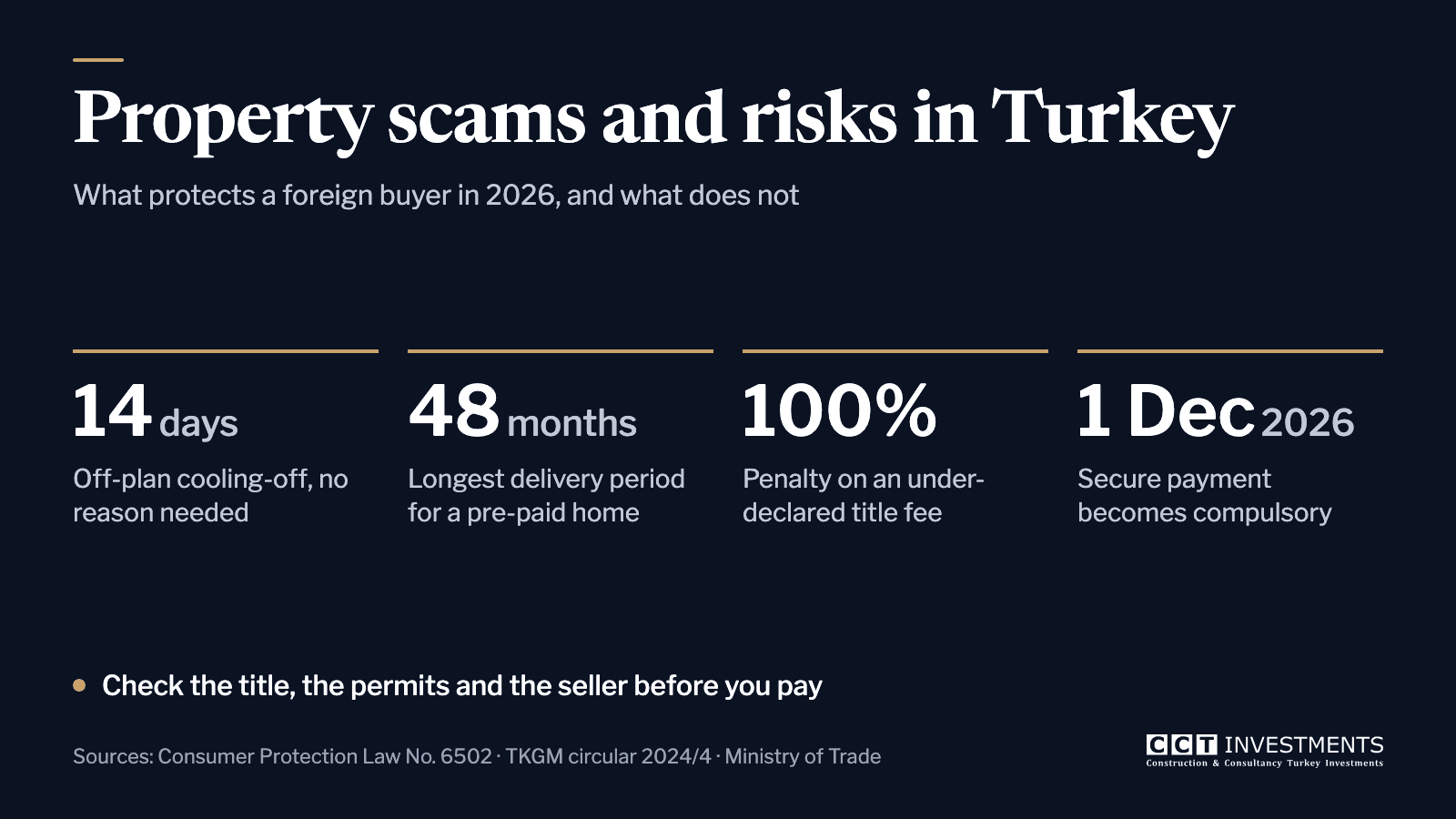
| Cooling-off | 14 days to withdraw, with no reason and no penalty |
| Delivery | By the contract date, and never later than 48 months after signing |
| Later withdrawal | Up to 24 months after signing, with no reason needed |
If you withdraw after the cooling-off period, the seller can claim taxes and legal costs plus compensation of up to 2% of the price in the first 3 months, 4% from 3 to 6 months, 6% from 6 to 12 months and 8% from 12 to 24 months. The rest must come back within 180 days.
These rights are for consumers, meaning people buying a home for non-commercial purposes. An office, a purchase through a company or a buyer trading units may fall outside them, so ask a lawyer before relying on them.
To use this protection in practice:
- Insist on the notary. A contract signed at a sales office is not a sale promise. Under Article 237 of the Code of Obligations, a promise to sell property must be made in official form.
- Have the sale promise annotated on the title. The annotation binds anyone who acquires the unit later, for five years, which is your protection against the same unit being sold twice. Note the date: it lapses after five years, so ask your lawyer how to keep it in place if the project runs longer.
- Find out who owns the land. Many projects are built on land-for-flats deals (kat karşılığı), where some units belong to the landowner. Check that the unit you are buying belongs to the party selling it.
- Ask about any mortgage on the plot. If a bank holds one, ask how your unit will be released from it, and get the answer in writing.
- Treat guarantees with care. A rental or buy-back guarantee is a promise from the same company selling you the unit. Put it in the notarised contract and ask what happens if that company fails.
- Look at finished projects. Visit the developer's completed buildings and talk to the people living there.
5. Paying too much
Overpaying is not a crime, which is why nothing stops it but you. Ads aimed at foreigners can sit well above what Turkish buyers pay for similar homes, and a price per square metre can look better than it is if it is quoted on gross area. Learn the difference between gross and net square meters before you compare.
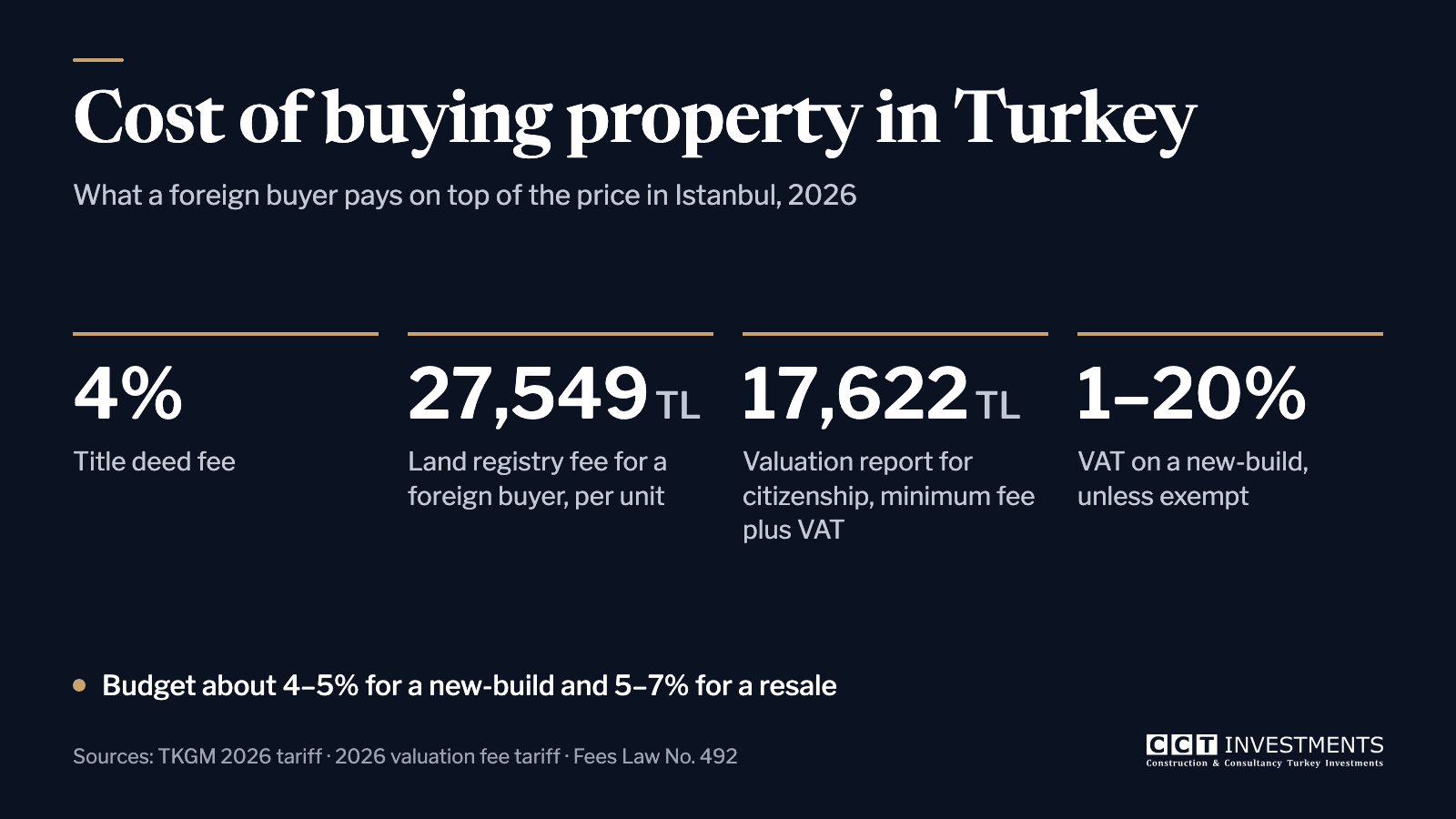
Compare asking prices on Turkish-language portals, ask a developer for the price list, and look at what has sold nearby. Outside citizenship purchases the Land Registry no longer asks for a valuation report, so nobody checks the price unless you do. Order your own from a firm licensed by the Capital Markets Board (SPK). It starts at 17,622 TL plus VAT in 2026. An independent report is the one you order yourself, not the one the seller hands you.
Refuse an under-declared price. A seller may suggest writing a lower price in the deed to save the title deed fee. The penalty on the missing fee is now 100%, up from 25%, and it falls on both buyer and seller. The tax office compares declared prices with market data. A low declared price also inflates your taxable gain when you sell, and for citizenship the price in the deed must reach the full USD 400,000.
6. How the money moves
Never pay in cash. Pay by bank transfer, keep every receipt, and keep the currency exchange document (döviz alım belgesi) if you bring in foreign currency. Citizenship files stand or fall on this paper trail.
The secure payment system becomes compulsory on 1 December 2026, after the Ministry of Trade moved the date from 1 October. You pay into the system, and the seller receives the money only after the title has passed to you. If the transfer fails, the money is not released to the seller. It covers homes, land and commercial property. The part financed by a bank stays outside it.
This closes one old gap: paying and then finding that no transfer follows. It does not cover everything. The rules for deposits are not yet settled, and an off-plan buyer pays instalments long before any title transfer, so sections 1 to 4 still apply. The detailed rules and the usage fee had not been published at the time of writing.
Power of attorney. Many foreign buyers complete by power of attorney, and this is normal. It can be issued by a notary in Turkey, at a Turkish consulate, or by a foreign notary with your certified photo and an apostille. In a country outside the Apostille Convention, the notary's document needs approval from the Turkish consulate instead. A broad one is dangerous, so name the property and the person, leave out any right to sell or mortgage it for you or to appoint someone else, and set an end date. Revoke it at a notary when the job is done.
Translation. If you do not speak Turkish, the Land Registry requires a sworn translator at the transfer. Ask for a full translation of any contract before you sign it, not a summary at the table.
7. Citizenship: the file is now the risk
Turkey has been cancelling citizenship files built on inflated property deals. In August 2026 the Interior Ministry said 1,150 investors had lost their certificates of conformity over irregular transactions, cancelling the citizenship of 5,391 people including family members. A second wave in September 2026 concerned 1,070 foreigners and USD 72.25 million of sales that investigators say did not reflect reality. Thirty companies were placed under trustees.
The pattern was low-value property shown at a high value in inflated reports, while the required foreign currency never really came into the country. The sums behind the sales came from intermediaries or the sellers themselves.
The rules tightened in response. Under the Land Registry's circular as amended on 28 September 2026:
- The price declared in the deed and the total of your bank transfers must each reach USD 400,000.
- Both must be confirmed by an amount determination certificate (tutar tespit belgesi, TTB), based on a valuation report from an SPK-authorised firm. Sales by public bodies and real estate investment trusts follow a separate route.
- The report is requested through Web Tapu, and the TTB is sent electronically. A paper TTB is not accepted.
- The TTB must be no more than 12 months old when you apply for the transaction.
Walk away if you hear any of these:
- "USD 400,000 on the deed, but you really pay less." Any refund or cashback puts your whole family's citizenship at risk.
- "We will lend you part of the money." The foreign currency must really come into Turkey through a bank, under your name.
- "We guarantee the passport" or "you will have it in 60 days." Approval is a state decision, and it takes about 180 days.
Check three things as well. The seller must be a Turkish citizen or Turkish company, because the property must not have been registered to a foreign person after 12 January 2017. The title must be in your own name; a purchase in the name of a spouse, a child or your company does not count. And the other conditions must be met: USD 400,000, a three-year no-sale annotation, and a building or unit rather than bare land. Your spouse and children under 18 are included in your file.
Red flags at a glance
- Pressure to pay today, or a discount that ends tonight
- A personal bank account for a property payment
- A price far below similar homes nearby
- No permit, no title record, or documents only as WhatsApp photos
- "You don't need a lawyer" or "you don't need your own translator"
- A request to declare a lower price in the deed
- A promise that the seller refuses to put in the contract
If something goes wrong
Stop paying and keep everything: contracts, receipts and messages. Within the first 14 days of an off-plan contract, send your withdrawal notice at once, by notary if you can. Then see an independent lawyer. A lawyer can ask a court for an injunction recorded on the title so that the property cannot be sold while the dispute runs, and can file a complaint with the prosecutor if there is fraud. Disputes over property in Turkey go to the Turkish courts.
Frequently asked questions
Is it safe for foreigners to buy property in Turkey?
Yes, if you make the checks first. The title register is run by the State, which is liable for damage arising from it, and foreign buyers go through the same registry office as Turkish buyers. The risks sit before the transfer, in the deposits, contracts and instalments.
How do I check a title deed before buying?
Ask the seller for a Web Tapu record dated that day, or go with the seller to the Land Registry. Check that the owner matches the seller's identity document, and look for any mortgage, seizure or annotation. Check again on the morning of the transfer.
Can I get my money back on an off-plan purchase?
Under the Consumer Protection Law, a consumer can withdraw from a pre-paid home sale within 14 days with no reason and no penalty. Up to 24 months you can still withdraw, and the seller can claim costs and up to 2–8% of the price, depending on how much time has passed. Refunds are due within 180 days.
Do I need a lawyer to buy property in Turkey?
It is not compulsory. For an off-plan or citizenship purchase, an independent lawyer you pay yourself is good protection. See do you need a lawyer to buy a house in Turkey.
Will the secure payment system end property scams?
It removes the risk of paying at the transfer and not getting the title. It does not check the property, the price or the permits, and it does not protect a deposit or off-plan instalments paid long before the transfer.
Can I lose Turkish citizenship because of a property deal?
Yes. Citizenship obtained through false information or forged documents can be cancelled, and the 2026 cases show the cancellation reaching family members as well. The citizenship guide sets out the procedure.
For help checking a specific property, contact us. The buyer guide explains each step of a purchase.
This guide gives general information and is not legal advice. Rules change; check the current position with a lawyer before you buy.
Sources
- Tapu ve Kadastro Genel Müdürlüğü: circular 2024/4 as amended on 28 September 2026
- Tapu ve Kadastro Genel Müdürlüğü: guide for foreigners acquiring property in Turkey
- Mevzuat: Consumer Protection Law No. 6502
- Ministry of Trade: verified listing system announcement
- NTV: verified listings for sales start on 15 February 2026
- CNN Türk: how a verified listing looks
- CNN Türk: Interior Ministry figures on cancelled citizenship, 5 August 2026
- Evrensel: operation over 1,070 citizenships, 25 September 2026
- Gazete Oksijen: trustees appointed to 30 companies
- Endeks24: how the sham sales worked
- Emlak Haberi: secure payment system before 1 December
- Alp Kemal Gözel: the secure payment system, scope and exceptions
- Milliyet: penalty on under-declared title prices
- Hukuki Haber: State liability for the land register
- Hukukçular Evi: building registration certificate after the zoning amnesty
- Hukuki Haber: guarantee rules for projects of 30 homes or more
- Bilal Alyar: sale promise contracts and the five-year annotation