Cost of Buying Property in Turkey in 2026: Taxes, Fees and a Worked Example
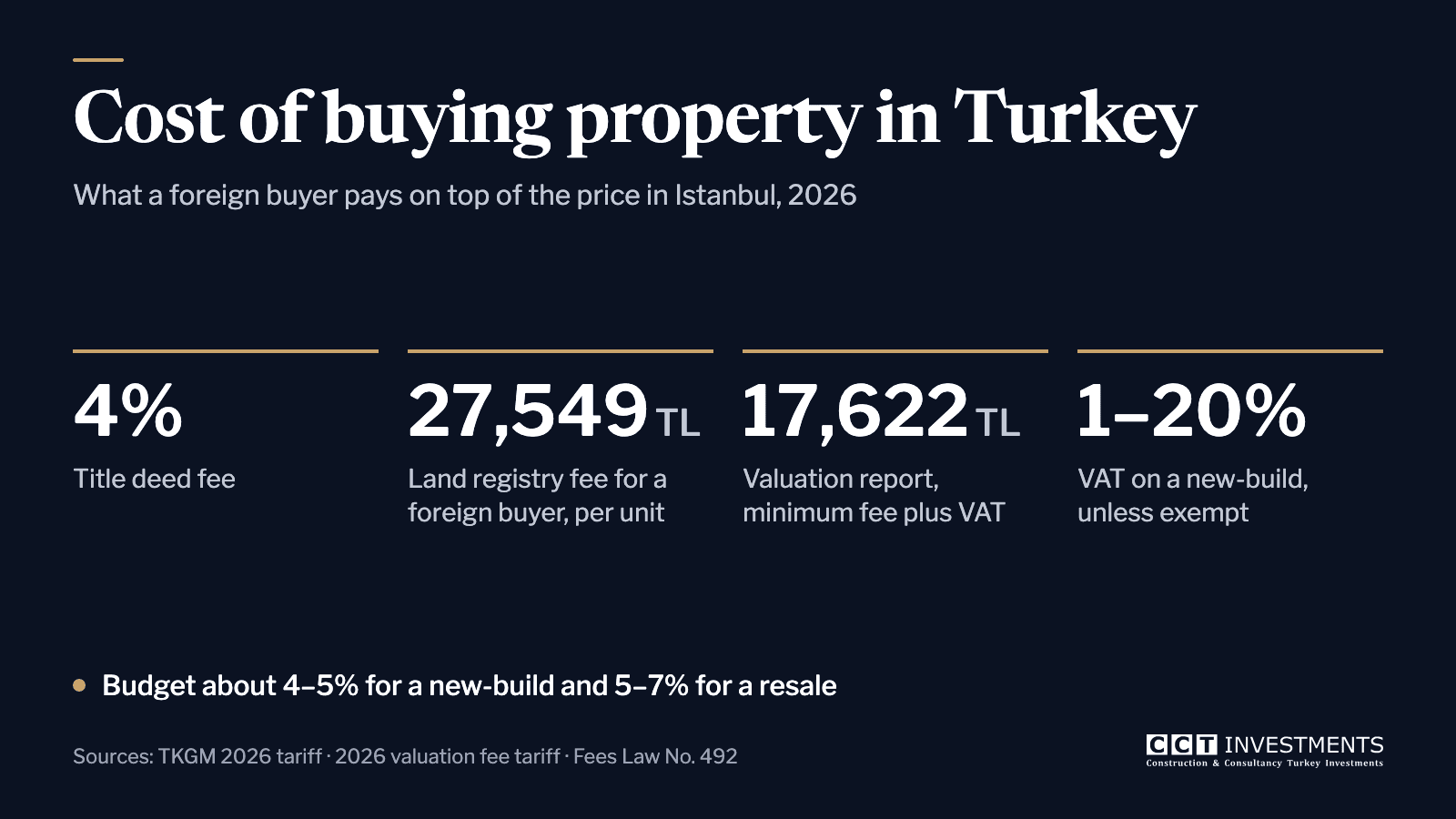
On top of the purchase price, a foreign buyer in Turkey should budget about 4–5% for a new-build bought directly from a developer and about 5–7% for a resale bought through an agent. The largest item is the title deed fee of 4% of the declared price. Foreign buyers in Istanbul also pay a land registry service fee of 27,549 TL per property and a valuation report from 17,622 TL plus VAT. A new-build can add VAT of 1%, 10% or 20% unless you qualify for the exemption. All figures below are for 2026; most of them change every January.
Key figures at a glance
| Cost | Who pays | 2026 amount |
|---|---|---|
| Title deed fee (tapu harcı) | 2% buyer + 2% seller by law; developers often pass all of it to the buyer | 4% of the declared price |
| Land registry service fee (döner sermaye) | Buyer | 6,681 TL in Istanbul + 20,868 TL per unit when a foreigner is a party = 27,549 TL |
| Valuation report | Buyer | From 17,622 TL + VAT (homes up to 250 m² gross) |
| VAT on a new-build | Buyer | 1%, 10% or 20% for homes, 20% for commercial property; exemption possible |
| Agency fee | Buyer and seller equally, unless agreed otherwise | Up to 4% + VAT in total; CCT charges buyers nothing on new-builds and 2% + VAT on resales |
| Sworn translator | Buyer, if you do not speak Turkish | Agreed with the translator |
| Compulsory earthquake insurance (DASK) | Buyer | Depends on size, building type and risk zone |
| Lawyer | Optional | Agreed in writing |
| Property tax, every year | Owner, from the year after purchase | 0.2% of the tax value for homes in metropolitan areas such as Istanbul, 0.1% elsewhere |
1. Title deed fee: 4% of the price
The title deed fee is set by the Fees Law (No. 492). It is 2% from the buyer and 2% from the seller, calculated on the price declared at the land registry. Who actually pays is decided in the contract: in new-build sales, developers' contracts often put the whole 4% on the buyer, and in resales it is negotiated. Read the contract before you sign.
The declared price cannot be lower than the property's tax value (emlak vergisi değeri), which the municipality sets and which is usually well below market value. Declare the real price. If the declared price is too low, the tax office can charge the difference with penalties. Your declared price also becomes your purchase cost when you sell, so under-declaring raises your capital gains tax later. Citizenship buyers have no choice: the deed must show the full investment.
The fee is paid in Turkish lira, at a bank or online, before the title deed appointment. On a 10,000,000 TL home, it comes to 400,000 TL in total.
2. Land registry service fee: 27,549 TL in Istanbul
Every title deed transaction also carries a fixed service fee to the Land Registry and Cadastre (TKGM). The 2026 tariff, in force since 1 January 2026, sets it at 2,227 TL times a regional coefficient. In Istanbul that comes to 6,681 TL.
When a foreigner is a party to a sale, item 1.11 of the tariff adds 20,868 TL for each property or unit. A foreign buyer in Istanbul therefore pays 27,549 TL per unit, and someone buying two flats pays it twice. The fee includes VAT. A mortgage registered at the same time is charged as a separate transaction.
3. Valuation report: from 17,622 TL plus VAT
Foreign buyers must have a valuation report before the transfer. It has to come from a valuation firm licensed by the Capital Markets Board (SPK). For citizenship, the report must show a value of at least USD 400,000.
The 2026 minimum fees were published in the Official Gazette of 31 December 2025:
| Home or office, gross area | Minimum fee, 2026 |
|---|---|
| Up to 250 m² | 17,622 TL |
| 251–500 m² | 20,217 TL |
| Above 500 m² | 23,946–55,569 TL |
VAT at 20% and small fixed shares for the valuation information centre and the valuers' association (TDUB) come on top. A home up to 250 m² therefore costs about 21,150 TL with VAT. The fee goes by gross area; see gross and net square meters for the difference.
4. VAT on new-builds
VAT applies only when you buy from a developer or another business. A resale between private individuals has no VAT.
On new homes, VAT is 1%, 10% or 20%, depending on the net floor area, the date of the building permit and the land value. Offices and shops are charged 20%. Always ask whether the quoted price includes VAT.
A foreign buyer who is not resident in Turkey can be exempt when buying a new home or office directly from the developer and paying in foreign currency brought from abroad. There is no limit on the number of units. If you sell within three years, the VAT that was not charged becomes payable. The conditions are in our guide to the VAT exemption for foreign buyers.
5. Agency and lawyer fees
The Regulation on Real Estate Trade caps an agent's fee on a sale at 4% of the price plus VAT in total. Unless agreed otherwise in writing, it is shared equally between buyer and seller, so a buyer usually pays 2% + VAT (2.4% with VAT at 20%).
On new-build projects, the developer normally pays the agent. CCT charges no commission to buyers of new-builds; on resales, our fee is 2% + VAT. Whoever you work with, ask to see the agency's authorisation certificate (Taşınmaz Ticareti Yetki Belgesi). Ours is No. 3405667.
A lawyer is not compulsory, but many buyers use one. Agree the fee in writing before any work starts: some lawyers charge a fixed fee, others a percentage. See do you need a lawyer to buy a house in Turkey?
6. Translator, power of attorney and notary
- Sworn translator. If you do not speak Turkish, a sworn translator must attend the title deed appointment with you. The fee is set by the translator, so agree it in advance.
- Buying from abroad. You can give a power of attorney at a Turkish consulate, or at a notary in your own country with an apostille and a sworn translation in Turkey. CCT can complete the title deed procedures by power of attorney. Applications for a residence permit or citizenship must still be made in person.
- Notarised off-plan contracts. Some developers sign the off-plan contract at a notary as a promise to sell (satış vaadi sözleşmesi). This adds notary fees and stamp duty. Ask the developer in writing who pays them.
7. Earthquake insurance, utilities and the exchange certificate
- DASK. Compulsory earthquake insurance must be valid when the title deed is transferred. The premium depends on the floor area, the building type and the earthquake risk zone, and the policy is renewed every year.
- Utilities. Electricity, water and gas each need a new subscription in your name, usually with a refundable deposit.
- Currency exchange certificate. Foreign buyers need a certificate from a Turkish bank showing that foreign currency was converted for the purchase. The real cost is the bank's exchange rate and transfer fees, so compare banks before you send a large amount.
- Tax number. You need a Turkish tax number to buy. It is free.
New in 2026: the secure payment system
A Ministry of Trade regulation published on 29 April 2026 requires the price of a property sale to be paid through a secure payment system that releases the money and the title deed at the same time. Bank loans are outside it. The system was optional until 1 July 2026; a later regulation moved the compulsory start to 1 December 2026.
Each transaction carries a usage fee, which is deducted from the money paid to the seller. The rate had not been published at the time of writing. We will update this guide when it is.
Worked examples
Both examples assume an Istanbul home and USD 1 = 49.5 TL, the rate in late October 2026. The translator, DASK and utility amounts are estimates.
A. A USD 400,000 new-build for citizenship, bought directly from the developer, VAT-exempt, with the buyer paying the whole title deed fee and no agency fee:
| Item | TL |
|---|---|
| Price (USD 400,000) | 19,800,000 |
| Title deed fee, 4% | 792,000 |
| Land registry service fee | 27,549 |
| Valuation report with VAT | 21,146 |
| Translator (estimate) | 5,000 |
| DASK (estimate) | 3,000 |
| Utility deposits (estimate) | 5,000 |
| Total costs | 853,695 (about USD 17,250, or 4.3%) |
B. A USD 250,000 resale bought through an agent, with the title deed fee split 2% / 2%:
| Item | TL |
|---|---|
| Price (USD 250,000) | 12,375,000 |
| Buyer's title deed fee, 2% | 247,500 |
| Agency fee, 2% + 20% VAT | 297,000 |
| Land registry service fee | 27,549 |
| Valuation report with VAT | 21,146 |
| Translator, DASK, utilities (estimates) | 13,000 |
| Total costs | 606,195 (about USD 12,250, or 4.9%) |
If the seller in example B asks you to pay the full 4% title deed fee, the total rises to 853,695 TL, or 6.9%. Neither example includes a lawyer, a mortgage or VAT.
Costs after you buy
- Property tax (emlak vergisi). Homes pay 0.1% of their tax value a year, doubled to 0.2% inside metropolitan municipalities such as Istanbul. The tax value is set by the municipality and is usually far below the market price. You pay from the year after your purchase, in two instalments due by the end of May and the end of November. Check with the municipality that the account is in your name.
- High-value home tax (değerli konut vergisi). In 2026, it applies only where a home's tax value is above 17,711,000 TL, at 0.3% to 1% of the part above that. Owners whose only home in Turkey is that property are exempt.
- Building service charge (aidat). Set by each building or compound. Ask for the latest yearly budget before you buy; it can be high in compounds with pools and security.
- DASK renewal every year, and optional home insurance.
- Rental income tax if you let the home out: see our rental income tax guide for 2026.
When you sell, you pay the seller's 2% title deed fee, any agency fee and, depending on when you bought, capital gains tax. Homes bought before 1 January 2025 are exempt after five years. Homes bought from 2025 onwards are taxed at 15–40% on the gain, after an adjustment for inflation.
Extra costs for citizenship and residence
- Citizenship needs a property investment of at least USD 400,000, with a three-year no-sale annotation on the title deed. Your spouse and children under 18 are included. Budget for translated and apostilled family documents, photos and the residence permit card, plus a lawyer if you use one. Processing takes about 180 days after the application. See Turkish citizenship by property and the procedure and documents.
- A residence permit through property needs a home worth at least USD 200,000. It is not automatic, and some Istanbul neighbourhoods are closed to new permits. See the USD 200,000 rule and the districts open for residence permits.
How to keep the costs down
- Ask the developer or agent for an itemised cost sheet before you pay a deposit.
- Agree in writing who pays the 4% title deed fee and whether the price includes VAT.
- If you qualify for the VAT exemption, send the money in foreign currency from abroad, as the rules require.
- Declare the real price at the land registry.
- Work with a licensed agency, and buy new-builds without paying commission.
Frequently asked questions
How much is the title deed fee in Turkey in 2026?
4% of the declared price: 2% from the buyer and 2% from the seller by law. In practice, the contract often puts all of it on the buyer.
Do foreigners pay more than Turkish buyers?
The title deed fee is the same. Foreign buyers pay an extra land registry fee of 20,868 TL per unit and must buy a valuation report. A non-resident foreigner can, however, be exempt from VAT on a new-build, which a Turkish resident cannot.
Can I pay the fees in dollars or euros?
No. Title deed and land registry fees are paid in Turkish lira.
How much should I budget in total?
About 4–5% of the price for a new-build bought directly from a developer, and 5–7% for a resale through an agent, plus VAT where it applies. The buyer guide explains each step of the purchase.
For an itemised cost sheet for a specific home, contact us.
This guide gives general information and is not tax or legal advice. Fees and rates change every year; check the current figures before you buy.
Sources
- Tapu ve Kadastro Genel Müdürlüğü: 2026 land registry fee tariff
- Tapu ve Kadastro Genel Müdürlüğü: 2026 tariff in force from 1 January 2026
- Alomaliye: 2026 minimum fee tariff for property valuation
- Alomaliye: Property Tax General Communiqué No. 88, high-value home tax for 2026
- Lexpera: amendment to the Regulation on Real Estate Trade, Official Gazette of 29 April 2026
- Timeturk: secure payment system postponed to 1 December 2026