Mortgage in Turkey for Foreigners: Who Can Borrow, How Much and at What Cost
Yes, a foreigner can get a mortgage from a Turkish bank. The law allows it, and the land registry registers a bank's mortgage on a foreign owner's title like any other. Two things decide whether you get one and on what terms: where you live, which sets the currency of the loan, and the value and energy class of the home, which set how much the bank may lend.
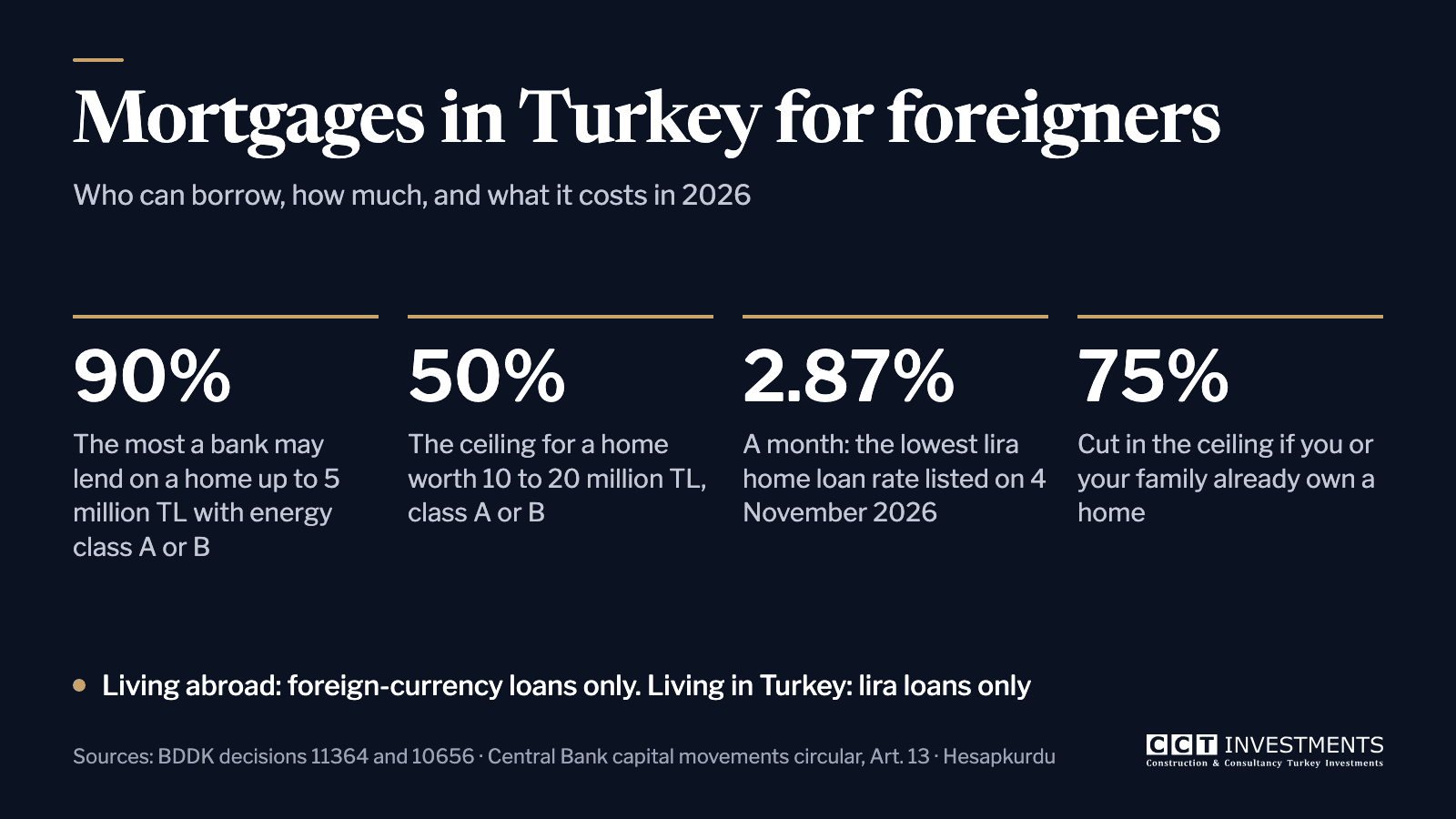
If you live abroad, the only loan you can use to buy property in Turkey is a foreign-currency loan. If you live in Turkey, you can borrow only in Turkish lira. In both cases the bank may lend at most 90% of a home worth up to 5 million TL, and only if its energy class is A or B. Above 10 million TL, the ceiling is 50% or less. Few Turkish banks lend to buyers who live abroad, so most foreign buyers pay the full price from their own funds or use a developer's payment plan.
This guide sets out the rules of the banking regulator (BDDK), the Central Bank and the consumer law, with figures as of 4 November 2026.
The short answer
| Question | Answer |
|---|---|
| Can a foreigner get a mortgage in Turkey? | Yes. The law allows it, but each bank decides, and few lend to buyers who live abroad |
| In which currency? | Foreign currency if you live abroad, Turkish lira if you live in Turkey |
| How much can I borrow? | 20% to 90% of the home's value, by value and energy class |
| If I already own a home | The ceiling is cut by 75% |
| Interest | Lira loans from about 2.9% to 3.8% a month in early November 2026; foreign-currency loans by individual offer |
| Fees | An allocation fee of at most 0.5% of the loan, plus the appraisal and mortgage costs at cost |
| Paying off early | Allowed, with a fee of at most 1% or 2% on a fixed-rate loan and none on a variable-rate loan |
| Citizenship | An outstanding foreign-currency loan is deducted; the rest must reach USD 400,000 |
The US dollar figures in this guide use USD 1 = 50 TL, close to the Central Bank's rate on 4 November 2026.
Where you live decides the currency
Turkey's currency rules treat a borrower according to whether they are resident in Turkey, that is, whether their legal home is here. A foreigner who has settled in Turkey, typically on a residence permit with a registered address, is resident. A foreigner who lives abroad and buys a holiday home or an investment property is not.
If you live abroad. The Central Bank's capital movements circular says that a foreign national who is not resident in Turkey can finance a property purchase here only with a foreign-currency loan. Before the title deed appointment, the bank sells the loan amount to the Central Bank, issues a currency exchange document for it, sends the document to the land registry and pays the seller in lira. The currency rules leave banks free to lend to non-residents, so the law is not the obstacle. Each bank's lending policy is, and few Turkish banks offer this loan.
If you live in Turkey. Under Decree No. 32 on the protection of the Turkish currency, a person resident in Turkey cannot take a foreign-currency loan from a Turkish bank, nor a loan indexed to a foreign currency. Your mortgage will be in Turkish lira. One practical point: the land registry asks every foreign buyer for a currency exchange document covering the sale price, and it makes no exception for residents, holders of long-term residence permits or people married to Turkish citizens. Before you apply, ask the bank how it will handle that document for the part of the price the loan pays.
The bank decides which group you belong to. If you hold a residence permit but spend most of the year abroad, ask at the start.
How much you can borrow
The ceiling comes from BDDK decision 11364 of 29 January 2026. It applies to every loan a bank gives a consumer to buy a home, and it depends on the value of the home and its energy class, taken from the building's Energy Identity Certificate (Enerji Kimlik Belgesi).
| Value of the home | Energy class A or B | Class C | Other classes |
|---|---|---|---|
| Up to 5 million TL (about USD 100,000) | 90% | 80% | 70% |
| 5 to 7 million TL (about USD 100,000 to 140,000) | 80% | 70% | 60% |
| 7 to 10 million TL (about USD 140,000 to 200,000) | 70% | 60% | 50% |
| 10 to 20 million TL (about USD 200,000 to 400,000) | 50% | 40% | 30% |
| Over 20 million TL (about USD 400,000) | 40% | 30% | 20% |
What follows from the table:
- The value is the bank's. The percentage applies to the value of the home the bank takes as security, which its appraiser sets. If the appraisal comes in below the price, you pay the difference.
- Many homes that foreign buyers choose fall in the higher-value rows. An apartment in a central Istanbul project often costs more than 10 million TL, so the bank may lend half of its value at most and you bring the other half, plus the buying costs.
- Newer buildings do better. Since January 2026 there is no difference between new and second-hand homes. The energy class decides. As the BDDK noted when it announced the change, class C is the minimum for buildings put up after 2010, while many older buildings have a lower class.
- If you already own a home, the ceiling falls by 75%. BDDK decision 10656 of 24 August 2023 still applies: when you, your spouse or a child under 18 owns at least one home, the bank must cut the ceiling by three quarters. On a class A home worth up to 5 million TL, 90% becomes 22.5%. A share of 50% or less in a single home is not counted, nor is a home in a village.
The bank can always lend less than the ceiling. It will look at your income and your other debts before it decides.
What a mortgage costs
Interest. On 4 November 2026 the comparison site Hesapkurdu listed lira home loans over 120 months at 2.87% to 3.83% a month, with Ziraat Bankası at 2.89%. A monthly rate of 2.89% equals about 41% a year, compounded. For a foreign-currency loan, ask the bank for a written offer.
A worked example for a buyer who lives in Turkey:
| Item | Amount |
|---|---|
| Price and appraisal | 6,000,000 TL (about USD 120,000), energy class B |
| Largest possible loan (80%) | 4,800,000 TL |
| Your own money | 1,200,000 TL, plus the buying costs |
| Monthly instalment, 120 months at 2.89% | about 143,400 TL (about USD 2,870) |
| Total repaid | about 17.2 million TL |
Over ten years you repay about 3.6 times the amount you borrowed. The loan is in lira, so if you earn in another currency, what each instalment costs you moves with the exchange rate.
Fees. The Central Bank's rules on fees for financial consumers limit what a bank may charge:
- Allocation fee: at most 0.5% of the loan amount.
- Appraisal and mortgage: only what the bank pays third parties, such as the appraisal firm and the land registry.
Insurance. The bank may tie insurance such as life cover to the loan only at your explicit written request, and it must also offer you the loan without it. If you buy cover from an insurer of your choice, the bank must accept it. Compulsory earthquake insurance (DASK) has to be in place for the title deed transfer anyway; our guide to the cost of buying property in Turkey lists it with the other costs.
Paying off early. You can repay part or all of the loan at any time, and the bank must reduce the interest to match. On a fixed-rate loan it may charge an early repayment fee of at most 1% of the amount repaid when 36 months or less remain, and 2% when more remain. On a variable-rate loan it may charge nothing.
Missed payments. The bank can demand the whole debt only after you miss at least two instalments in a row, and only after giving you at least 30 days' notice. If the debt is still unpaid, it can enforce its mortgage on the home.
Step by step
- Get a Turkish tax number and open a bank account. You need both for the purchase anyway, and banks usually lend to their own customers.
- Ask for a pre-approval before you commit to a property. Expect to be asked for your passport, your residence permit if you have one, proof of income such as payslips or tax returns, and recent bank statements. Documents from abroad usually need a notarised Turkish translation, and sometimes an apostille.
- Choose the property with the loan in mind. Ask for the Energy Identity Certificate and check the title. The bank registers its mortgage on the unit's own title, a construction-servitude or a condominium title, so for a home under construction ask the developer which banks finance units in the project.
- The bank's appraisal. A licensed appraiser values the home for the bank, and the loan is calculated on that value.
- The offer and the contract. The bank must give you a pre-contract information form with the terms a reasonable time before you sign. Compare the rate, the fees, fixed against variable interest, and the insurance.
- Title deed and mortgage on the same day. At the land registry the seller transfers the title to you, the bank's mortgage is registered on it, and the bank pays the loan to the seller. If you live abroad, the bank first converts the foreign-currency loan with a currency exchange document.
- Repay, then clear the title. When the loan is paid off, the bank releases the mortgage and the land registry deletes it from your title.
Mortgages and Turkish citizenship
You can buy a citizenship property with a mortgage, but while the loan is outstanding it does not count towards the USD 400,000. The Land Registry's guide to the citizenship regulation says that when a property is bought with a foreign-currency loan, the loan amount is deducted from the price and the remainder must still reach USD 400,000. If you pay off the loan and the mortgage is removed from the title, the application can go ahead on the amount shown in your currency exchange documents, which then has to reach USD 400,000. In practice, either your own foreign currency reaches the threshold from the start and the loan pays only for the part above it, or you repay the loan before you apply. The guide speaks of foreign-currency loans, the kind open to buyers who live abroad. If you live in Turkey and would borrow in lira, plan on the same basis, and ask a lawyer before you rely on a lira loan for a citizenship purchase.
Two more rules apply:
- A statutory mortgage (kanuni ipotek) on the title disqualifies a property, including one left from an earlier purchase, and when a foreigner buys, the unpaid price cannot be secured with one, except for a debt to a public body.
- A forced sale puts the file at risk. If a property bought subject to a mortgage or an attachment is sold through enforcement, the Land Registry reports it so that the certificate of conformity issued for the citizenship file is cancelled and the population and citizenship directorate is informed.
The citizenship application itself takes about 180 days, and your spouse and children under 18 are included (see our guide for families). Our guide to new-build or resale for citizenship covers which properties qualify.
Alternatives to a bank loan
- A developer payment plan. Many new-build projects ask for a down payment of 25–50% and spread the rest over 24 to 60 months, paid directly to the developer and usually without a credit check. For a foreign buyer the plan can be in US dollars or euros. A plan often costs more than the cash price, so compare the totals. Our guide to payment plans in Istanbul explains how they work.
- Borrowing in your own country. Some buyers borrow at home, for example against a property they own there, and pay the full price in Turkey without a Turkish loan. Rates abroad are often lower than Turkish lira rates; check the tax and currency effects with an adviser where you live.
When you buy a new-build through CCT Investments, you pay us no commission; the developer pays our fee. We can show you projects that offer payment plans.
Checklist before you apply
- You know whether the bank treats you as resident, and so whether the loan will be in lira or in foreign currency.
- You have the home's Energy Identity Certificate and know which row of the table it falls in.
- You have taken 75% off the ceiling if you, your spouse or a child under 18 already owns a home.
- You have the pre-contract information form and have compared the rate, the fees, and fixed against variable interest.
- You have your own money for the part the bank will not lend, plus the title deed fee and the other buying costs.
- For citizenship, your own foreign currency reaches USD 400,000 without the loan, or you plan to repay the loan before you apply.
Frequently asked questions
Can a foreigner get a mortgage in Turkey?
Yes. Turkish law allows banks to lend to foreigners, and a bank's mortgage is registered on a foreign owner's title like any other. Each bank decides whom it lends to, and few lend to buyers who live abroad.
Do I need a residence permit?
The law does not require one. Where you live decides the currency: a lira loan if you live in Turkey, a foreign-currency loan if you live abroad. In practice, banks lend mostly to foreigners who live in Turkey and have an income they can document.
Can I borrow in US dollars or euros?
Only if you live abroad. A borrower resident in Turkey can take neither a foreign-currency loan nor a loan indexed to a foreign currency.
How much of the price do I need to pay myself?
For a home with energy class A or B: at least 10% up to 5 million TL, at least 50% between 10 and 20 million TL, and at least 60% above that, plus the title deed fee and the other buying costs. More for a lower energy class, and much more if you already own a home.
Can I get Turkish citizenship with a mortgage?
Yes. While a foreign-currency loan is outstanding, it is deducted from the price and the rest must reach USD 400,000. If you repay the loan and the mortgage is lifted first, the amount in your currency exchange documents counts. The application takes about 180 days.
Can I pay off the loan early?
Yes. On a fixed-rate loan the fee is at most 1% of the amount you repay when 36 months or less remain, and 2% when more remain. On a variable-rate loan there is no fee.
Is a developer payment plan better than a mortgage?
They suit different buyers. A plan needs no bank and often no credit check, but it is limited to the developer's own projects and is often priced above the cash price. A mortgage lets you buy any home a bank will finance, new or resale, at the cost of the interest. Compare the total you will pay.
For homes that fit your budget and the way you plan to pay, see our Istanbul listings or contact us.
This guide gives general information and is not financial or legal advice. Bank terms and the rules change; check the current position with your bank and a lawyer before you commit.
Sources
- BDDK: decision 11364 of 29 January 2026 on loan-to-value ratios for housing loans
- BDDK: press release of 30 January 2026
- BDDK: decision 10656 of 24 August 2023 on borrowers who already own a home
- Central Bank of the Republic of Türkiye: capital movements circular (Article 13)
- TÜRMOB: Decree No. 32 on the protection of the value of the Turkish currency (Article 17/A)
- Mevzuat: Consumer Protection Law No. 6502 (Articles 33, 34, 37 and 38)
- Alomaliye: Central Bank communiqué 2020/7 on fees charged to financial consumers (Article 10)
- Your Key Türkiye (Land Registry): frequently asked questions, section 8 on the currency exchange document
- Türkiye Değerleme Uzmanları Birliği: the Land Registry's guide to the citizenship regulation, version of 1 February 2024
- Hesapkurdu: housing loan rates, 4 November 2026
- Central Bank of the Republic of Türkiye: exchange rates of 4 November 2026