New-Build or Resale for Turkish Citizenship: Which Properties Qualify
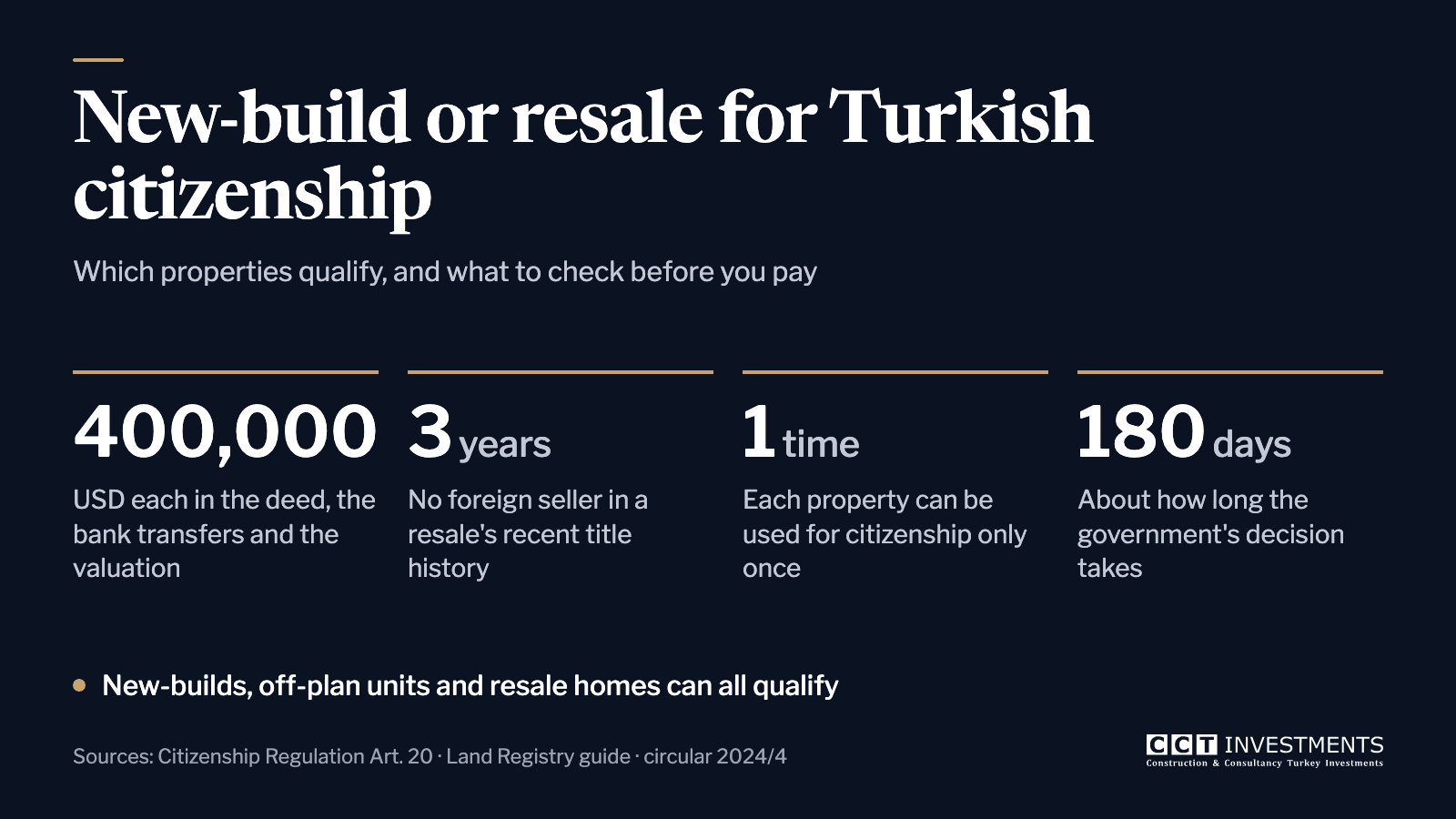
Both new-build and resale properties can get you Turkish citizenship. The law does not ask whether a property is new. It asks three things: is it the right type of property, does its value reach USD 400,000 in the deed, in your bank transfers and in an official valuation, and, for a second-hand property, who owned it before you. A new-build bought from a developer usually passes the third test without effort. A resale home can pass it too, but only after a look at its title history.
This guide sets out the rules that apply to every citizenship purchase, then what changes for a completed new-build, an off-plan unit and a resale home. The rules come from Article 20 of the regulation under the Turkish Citizenship Law and from the Land Registry's guide to that article.
The short answer
| Route | Qualifies? | What decides it |
|---|---|---|
| Completed new-build from the developer | Yes | A Turkish developer as seller (foreign-capital firms only on conditions) and a valuation that confirms the price |
| Off-plan unit, notarised sale promise | Yes | Construction servitude in place and USD 400,000 paid by the date of the contract |
| Resale (second-hand) home | Yes | The title history: no foreign seller in the last three years, never used for citizenship |
| A share of a property | No | The whole property must be in your name |
| Bare land, farmland, timeshare | No | Not an eligible type of property |
Whichever route you take, the government's decision takes about 180 days from the application, and your spouse and children under 18 are included in the same file (see our guide for families).
Rules for every property
The type of property. Since 12 December 2023, a citizenship property must be an independent unit with condominium title (kat mülkiyeti) or construction servitude (kat irtifakı), or a plot registered as building land with a permanent building on it that has an occupancy permit. Apartments, villas, offices and shops all qualify. Bare land, agricultural land and timeshares do not. Our note on occupancy permits and condominium title explains the two kinds of title.
The value, three times. The price declared in the title deed, the total of your bank transfers to the seller and the amount determination certificate (tutar tespit belgesi, TTB) issued with the valuation report must each reach USD 400,000. If the TTB comes in lower, the application is refused. The valuation report guide explains how the report is ordered.
The price only. The foreign currency you sell to a Turkish bank is recorded on a currency exchange document (döviz alım belgesi). That amount may contain only the price: VAT, commission, fees and taxes cannot be part of it, so they come on top of the USD 400,000.
In your name, and the whole of it. The property must be bought in your own name. A purchase in your spouse's or child's name, or through your company, does not count for you. A share does not qualify, but buying the whole of a property that several people own together does.
Several properties are fine. There is no limit on the number of properties, and they do not have to be bought on the same day. Two apartments of USD 200,000 each can make up the amount, as long as each one meets the other rules.
Three years without selling. A note is entered on the title that you will not sell for three years. Each property can be used for citizenship only once.
Never from a foreigner. The person selling to you cannot be a foreign national. For this rule, someone who became a Turkish citizen through investment counts as a foreigner too.
New-build from a developer
A unit sold for the first time by a Turkish developer is the simplest case: no buyer has owned it before, so the title history rules have nothing to catch. A few checks still matter.
Who owns the unit. Many Istanbul projects are built on land-for-flats deals (kat karşılığı), where part of the units belong to the landowner. Check in the title record that the unit is registered to the party selling it to you.
Foreign-capital developers. A developer that has foreign shareholders can sell for citizenship only on conditions: the construction servitude or condominium title was set up in the company's own name, the unit has never been transferred before, and the company made the whole construction investment itself. That is shown by the building permit, if the company has held it and been the contractor from the start, or otherwise by a contract showing that it paid for the construction. If such a company owns the land and another firm built the project under a land-for-flats contract, the units registered to the building firm can qualify, and the units the landowner company keeps cannot. Ask the developer before you reserve.
Real estate investment companies. Several large Turkish developers are listed real estate investment companies (gayrimenkul yatırım ortaklığı, GYO). For their sales, the company can use the valuation report for the unit that it published on the Public Disclosure Platform (KAP) before the sale, or order a new report through Web Tapu.
List price against valuation. New launches are often priced above what a valuer will confirm, especially early in a project. The owner of the unit requests the valuation through Web Tapu, so ask the developer to order it before you pay more than a reservation fee. You then know the TTB reaches USD 400,000 before you commit.
VAT. A new home carries VAT of 1%, 10% or 20%, and an office or shop 20%. A non-resident foreign buyer who pays in foreign currency from abroad can be exempt. The cost guide and the VAT exemption guide give the details.
CCT charges buyers no commission on new-builds; the developer pays our fee.
Off-plan: buying with a notarised sale promise
You can apply for citizenship before the building is finished. The title stays with the developer, and you sign a sale promise contract (satış vaadi sözleşmesi) before a notary, which is then annotated on the title. The rules are stricter than for an outright purchase:
- Construction servitude first. The building must have construction servitude or condominium title. A project that has only a building permit does not qualify yet.
- USD 400,000 paid up front. The whole USD 400,000 must be paid by the date of the notarised contract, and the currency exchange document for it must be dated no later than the contract. Payments made after that date do not count towards the USD 400,000. Further instalments above that amount are allowed.
- One contract. Several units can be put in a single contract, but two separate contracts cannot be added together. A shortfall on properties you have already bought cannot be made up with a sale promise either.
- From the registered owner. The unit must be registered to the party promising to sell it. A contract bought from another buyer cannot be used, and a unit can carry only one citizenship commitment.
- Three years, then the title. Your commitment is noted on the title: the contract will not be transferred or cancelled for three years, and the note is not removed until the title passes to you. If the title passes within the three years, the remaining period is carried over to your title deed.
Off-plan is where most of your money is exposed before you own anything. Read the off-plan section of our guide to property scams and risks before you sign, and see projects with payment plans for how instalments usually work.
Resale: the title history decides
A second-hand property qualifies on the same terms as a new one, plus conditions on its past. They exist to stop properties from changing hands between foreigners, relatives and their companies only to produce citizenship files.
| The property must not | Look back |
|---|---|
| Be registered now to a foreign national or to someone who became Turkish through investment | Today |
| Be registered now to your Turkish-citizen first-degree relatives | Today |
| Be registered to a company where you or your first-degree relatives are a partner or a manager | Today |
| Have been transferred to a Turkish citizen or company by a foreigner or an investment citizen | The last three years |
| Have been transferred to a Turkish citizen or company by you or your first-degree relatives | Ever |
| Have been used for citizenship before | Ever |
First-degree relatives are parents and children, including relatives by marriage, such as parents-in-law and stepchildren, and by adoption. The guide does not mention a purchase from your own spouse separately, so take legal advice before relying on one. Transfers made under a building contract, such as units passing to the contractor in a land-for-flats deal, are outside the three-year rule.
Debts on the title. A property with an ordinary mortgage or an attachment can be bought, but the amounts registered against it are left out of the investment calculation, so have the debt paid off and the entry removed at or before the transfer. If you buy with a foreign-currency loan, the loan is deducted from the price, and what remains must still reach USD 400,000. A property with a statutory mortgage (kanuni ipotek) cannot be used, and neither can one with an annotation that could change its ownership, such as an earlier sale promise or a pending lawsuit.
The date you may read elsewhere. You will often read that a property must not have belonged to any foreigner since 12 January 2017. The Land Registry's rules today look at the last three years for other foreigners, and at your own family without a time limit. The 2017 date matters for something else: purchases made before 12 January 2017, when the property route began, do not count at all.
How to check a resale property
- Ask for the title record and its history. A lawyer can obtain the current record and the earlier entries from the land registry. They show who sold to the present owner and when.
- Ask how the seller acquired it. If they bought within the last three years, find out from whom. A seller born a foreign national may have become Turkish through investment.
- Read the declarations section. A note that the owner committed not to sell for three years under Article 20 means the property has already been used for citizenship. It cannot be used again, even after the note has been removed.
- Clear the debts before the transfer. Agree in writing that any mortgage is paid off and removed at or before the transfer.
- Check the building. Ask for the occupancy permit (iskan). A building permit dated from 1 January 2019 means the design had to follow the current earthquake code.
The Land Registry checks all of this when it records your purchase, but by then you will have paid a deposit. Make the checks before you pay anything.
Which route suits you
| New-build | Off-plan | Resale | |
|---|---|---|---|
| Title history checks | Few | Few | Several, see above |
| VAT | 1–20%, exemption possible | 1–20%, exemption possible | None from a private seller |
| CCT fee to the buyer | None | None | 2% + VAT |
| Payment | Usually in full | USD 400,000 by the contract date, the rest by plan | In full |
| Rental income | From the transfer | After delivery | From the transfer |
| Risk to watch | Price against valuation | Delivery and the developer | The title history and the building's age |
A resale home lets you see the building, the neighbours and the actual rent before you buy, and a private seller charges no VAT. A new-build saves you most of the history checks and may come with a VAT exemption. Off-plan spreads the cost beyond USD 400,000 and often starts from a lower price, in exchange for waiting and for trusting the developer.
Think about the sale as well. Once a property has been used for citizenship, it can never qualify again. When you sell after the three years, your buyers will be Turkish buyers and foreigners who are not applying for citizenship. Selling it back to the person you bought it from is reported to the General Directorate of Population and Citizenship Affairs, which can review how your citizenship was obtained.
Checklist before you pay a deposit
- The property is a unit with condominium title or construction servitude, or a building with an occupancy permit on building land.
- The seller is not a foreign national, an investment citizen, one of your Turkish-citizen first-degree relatives or a company that you or they run or own part of.
- For a resale: no foreigner or investment citizen transferred it to a Turkish citizen or company in the last three years, you and your first-degree relatives never did, and it has never been used for citizenship.
- For off-plan: construction servitude exists, and you can pay USD 400,000 by the date of the notarised contract.
- The valuation has been ordered, and the price in the deed, your bank transfers and the TTB will each reach USD 400,000, with VAT, fees and commission on top.
- The title is free of statutory mortgages and of annotations that could change ownership.
- Every payment goes through a bank in your name, with the currency exchange document. Our step-by-step procedure covers the documents.
Frequently asked questions
Can I buy a resale property to get Turkish citizenship?
Yes. A second-hand apartment, villa, office or shop qualifies if it reaches USD 400,000 three ways, was not transferred by a foreigner or an investment citizen in the last three years, has never been used for citizenship, and has no link to you or your first-degree relatives.
Can I buy from a foreigner who owns property in Turkey?
Not for citizenship. The seller cannot be a foreign national, and someone who became Turkish through investment is treated as a foreigner for this rule. A property that a foreigner sold to a Turkish citizen can qualify once three years have passed since that sale.
Does the property have to be new?
No. Age does not matter for eligibility. It matters for the valuation, the earthquake safety of the building and your resale price, so check it anyway.
Can I buy off-plan with a payment plan?
Yes, if the building has construction servitude and you pay at least USD 400,000 by the date of the notarised sale promise. The rest of the price can follow in instalments.
Can I combine two or three properties?
Yes, when you buy them outright, with no limit on the number and no need to buy them on the same day. With sale promises, the units must all be in one contract.
Does VAT count towards the USD 400,000?
No. The amount in the currency exchange document covers the price only. VAT, fees and commission are paid on top.
Can I use a property that someone else used for citizenship?
No. A property can be used for citizenship only once.
For a shortlist of new-build and resale properties that pass these checks, see our Istanbul listings or contact us.
This guide gives general information and is not legal advice. Rules change; check the current position with a lawyer before you buy.
Sources
- Mevzuat: Regulation on the Implementation of the Turkish Citizenship Law (Article 20)
- Your Key Türkiye (Land Registry): acquiring citizenship through property
- Your Key Türkiye (Land Registry): frequently asked questions, section 7
- Türkiye Değerleme Uzmanları Birliği: the Land Registry's guide to the citizenship regulation, version of 1 February 2024
- Tapu ve Kadastro Genel Müdürlüğü: circular 2024/4 as amended on 28 September 2026