Capital Gains Tax When You Sell Property in Turkey: How Foreign Owners Work It Out
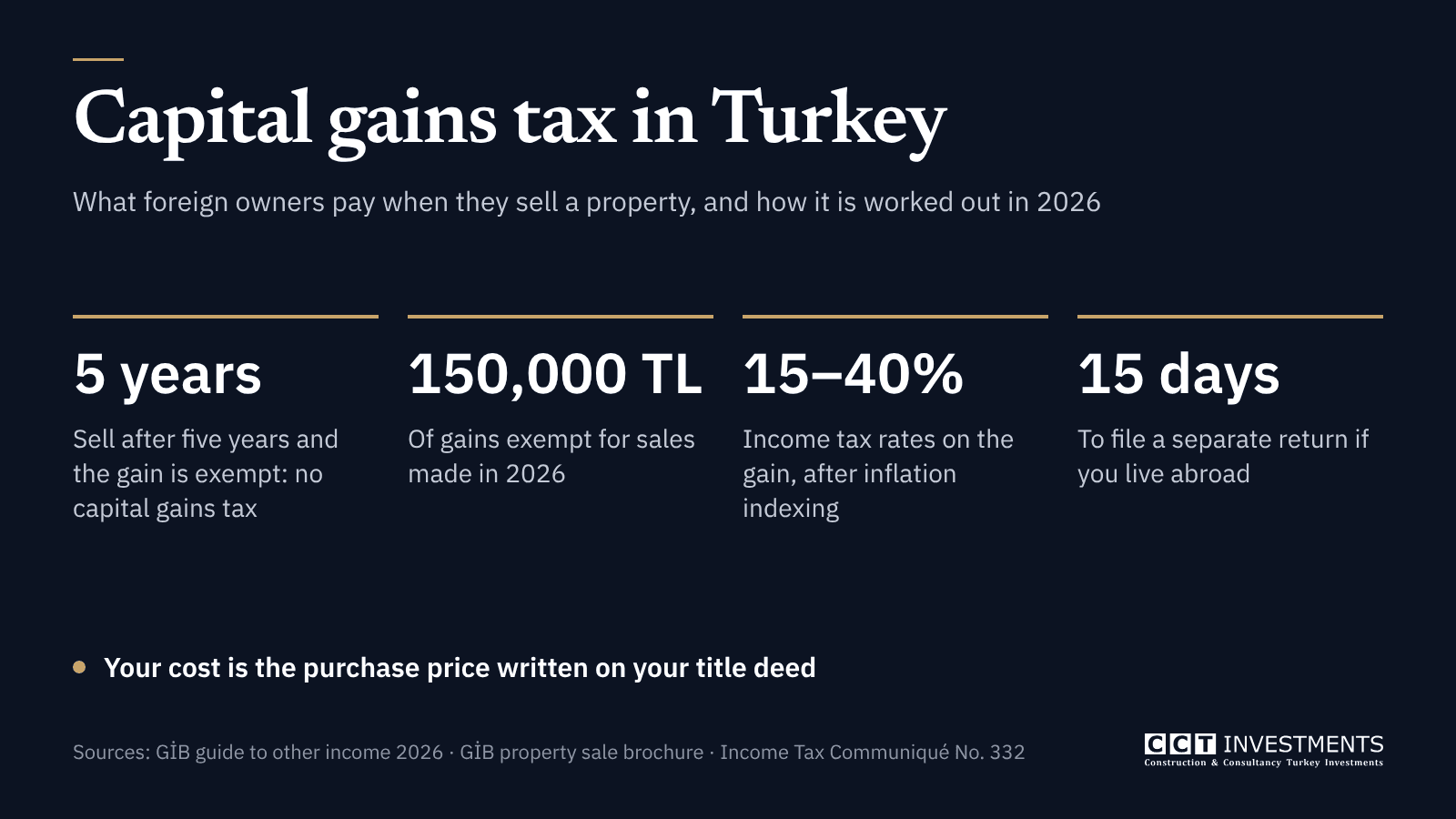
Yes, if you sell within five years. Turkish income tax law treats the profit on a property sold within five years of buying it as a capital gain (değer artışı kazancı) and taxes it as income, at the progressive rates of 15% to 40%. Three things soften the bill: the purchase price is indexed for inflation, the seller's own sale costs are deducted, and the first 150,000 TL of gains in 2026 is exempt. A property you inherited is outside these rules.
Sell more than five years after you bought, and you pay no capital gains tax at all. The five-year exemption still applies in 2026. Where you live decides how you declare a sale within the five years. If you live in Turkey, the gain goes into your annual income tax return in March of the following year. If you live abroad, you file a separate return at the tax office where the property is, within 15 days of the sale.
This guide sets out the rules from the Revenue Administration's (GİB) 2026 guide to other income and its brochure on property sales, with the rates and amounts that apply to sales in 2026, as of November 2026.
The short answer
| Question | Answer |
|---|---|
| When is the gain taxed? | Only when you sell within five years of acquiring the property for a price. After five years: exempt, no tax |
| Inherited property? | Not taxed as a capital gain, however soon you sell |
| What is taxed? | Sale price, minus the purchase price indexed for inflation, minus your sale costs and fees |
| Inflation indexing | By the producer price index (Yİ-ÜFE), only if it rose 10% or more |
| Exempt amount | 150,000 TL of gains for sales in 2026 (120,000 TL in 2025) |
| Rates | 15% to 40%, by bracket |
| If you live in Turkey | Annual return, 1–31 March of the next year; tax paid in two instalments, March and July |
| If you live abroad | Separate return within 15 days of the sale, at the tax office where the property is |
When the five years start
The five years run from the day you acquire the property, normally the date the title deed is registered in your name. GİB's brochure makes two exceptions that matter for buyers of new homes:
- Possession before the title. If you were handed the property before the title was registered, as with some cooperative or public housing units, the five years can start on the handover date. You prove it with the allocation or handover documents, or with utility bills in your name.
- Flats received for land. A flat received under a land-for-flats agreement (kat karşılığı) counts as acquired when its title is registered, not when the land was bought.
Only property acquired for a price is covered. An apartment you inherited is not taxed as a capital gain, even if you sell it in the same year.
"The question I hear most often when the three-year citizenship period ends is whether the client can now sell. They can, but between year three and year five the gain is taxable. So before we agree a price, we sit down with the purchase documents and work out the indexed cost." — Cenan Can Tekin, Founder & General Manager, CCT Investments
How the gain is worked out
The taxable gain is:
sale price − purchase price indexed for inflation − the costs, taxes and fees you paid to sell
The seller's half of the title deed fee, 2% of the declared sale price, is one of those costs. If the original purchase cost cannot be established, the tax office uses a value set by the valuation commission instead.
Inflation indexing. The purchase price is increased by the change in the domestic producer price index (Yİ-ÜFE), published monthly by the Turkish Statistical Institute (TÜİK). You compare the index for the month before you bought with the index for the month before you sell; the month of sale is left out. Indexing applies only if the index rose by 10% or more over that period. For scale, TÜİK reported that the index rose 27.41% in the twelve months to October 2026, so for most properties held a year or more the adjustment is large.
The exemption. The first 150,000 TL of capital gains from sales in 2026 is exempt (120,000 TL for sales in 2025). If your net gain is below it, you have nothing to declare.
The amount on your title deed. The purchase price and the sale price that count are the amounts written on the title deeds, not what you transferred or paid. A purchase price on the deed below the real one means a lower cost now and a higher gain. Our guide to the cost of buying property in Turkey explains why we always advise declaring the real price.
The 2026 rates
The gain is taxed as income, at the rates for income other than wages. For income earned in 2026:
| Taxable income (TL) | Rate |
|---|---|
| Up to 190,000 | 15% |
| 190,000 to 400,000 | 28,500 TL + 20% of the amount above 190,000 |
| 400,000 to 1,000,000 | 70,500 TL + 27% of the amount above 400,000 |
| 1,000,000 to 5,300,000 | 232,500 TL + 35% of the amount above 1,000,000 |
| Over 5,300,000 | 1,737,500 TL + 40% of the amount above 5,300,000 |
The brackets apply to your total declared income for the year, so if you also declare rental income in Turkey, the gain is added to it. Our rental income tax guide covers that side.
A worked example
The figures below are for illustration. The index change is an assumption, not a forecast.
| Item | Amount |
|---|---|
| Purchase price on the title deed | 10,000,000 TL |
| Assumed rise in Yİ-ÜFE between the month before purchase and the month before sale | 60% |
| Indexed purchase price | 16,000,000 TL |
| Sale price, in 2026 | 20,000,000 TL |
| Seller's title deed fee (2%) | 400,000 TL |
| Net gain | 3,600,000 TL |
| Exempt amount for 2026 | 150,000 TL |
| Taxable gain | 3,450,000 TL |
| Income tax: 232,500 + 35% × 2,450,000 | 1,090,000 TL |
Without indexing, the taxable gain would be 9,450,000 TL and the tax 3,397,500 TL. Indexing cuts the bill by about two thirds in this example, which is why the dates and the documents matter.
How and when you declare
If you live in Turkey. For tax purposes you are resident if your legal home is in Turkey, or if you stay in Turkey for more than six months in a calendar year. A foreigner who comes for a set temporary job, or for study, treatment, rest or travel, is not treated as resident even after six months. A resident declares the gain in the annual income tax return, filed from 1 to 31 March of the year after the sale. The tax is paid in two equal instalments, by the end of March and by the end of July. A gain from a 2026 sale is declared in March 2027.
If you live abroad. A non-resident who has no annual return to file must file a separate return (münferit beyanname) at the tax office where the property is located, within 15 days of the sale. If you sell from abroad through a power of attorney, the 15 days still apply, so arrange the return with an accountant before the title deed appointment.
If you leave Turkey for good. A resident who leaves the country permanently files the return before leaving, within the 15 days before departure.
Your home country. Your country of residence may also tax the gain, depending on its own law and its tax treaty with Turkey. Check the position with an adviser where you live.
"When you sell, the tax office looks at one figure for your cost: the amount written on your title deed. Not what you paid, not what you transferred. So the price on the deed on the day you buy is the price your gain is measured from years later." — Cenan Can Tekin
Citizenship and residence permit owners
- Citizenship. A property bought for citizenship carries a three-year no-sale note on the title. Once it expires you may sell, but a sale in years three to five is still within the five years, so the gain is taxable. A property used for citizenship can never be used for citizenship again, so your buyers will be Turkish buyers and foreigners who are not applying for citizenship. Our guide to new-build or resale for citizenship explains that rule.
- Residence permit. If your residence permit rests on owning the property, selling it removes that basis. Plan your next permit before you sell.
Before you sell: checklist
- You know your acquisition date: the title deed registration, or the documented handover if that came first.
- You know the purchase price written on your title deed: that is your cost, not the amount you paid or transferred.
- You have checked whether five years have passed, and whether the property was inherited.
- You have the Yİ-ÜFE values for the month before purchase and the month before sale, and know whether the rise reaches 10%.
- You know whether you file as a resident (March) or as a non-resident (within 15 days).
- An accountant has checked the calculation before you agree the price.
Frequently asked questions
Do foreigners pay capital gains tax in Turkey?
Yes, on the same basis as Turkish owners: on a property acquired for a price and sold within five years. The difference is the filing: a non-resident files a separate return within 15 days of the sale.
Is there capital gains tax after five years?
No. If you sell more than five years after you acquired the property, the gain is exempt and there is no capital gains tax to pay or declare.
How much is the exemption in 2026?
150,000 TL of capital gains from sales made in 2026. It was 120,000 TL in 2025.
Can I deduct inflation?
Yes. The purchase price is increased by the rise in the producer price index (Yİ-ÜFE) from the month before purchase to the month before sale, provided the rise is 10% or more.
I sold from abroad. When do I declare?
Within 15 days of the sale, with a separate return at the tax office where the property is located.
Do I pay tax on an inherited property?
Not as a capital gain. A property acquired without payment, such as by inheritance, is outside the five-year rule. Our guide to inheritance law and inheritance tax covers the tax due on the inheritance itself.
When you are ready to sell, our Seller Guide explains how we handle the sale, from valuation to title deed, or contact us.
This guide gives general information and is not tax or legal advice. Rates and amounts change every year; confirm your own calculation with a Turkish accountant before you sell.
Sources
- GİB: Guide to the taxation of other income (Diğer Kazanç ve İratlar), 2026
- GİB: Income tax on property sold within five years, brochure, 2025
- KPMG Türkiye: 2026 income tax brackets and amounts, Income Tax Communiqué No. 332
- PwC Türkiye: Tax Bulletin 2026/02, 2026 income tax figures
- Ticaret Gazetesi: domestic producer prices, October 2026
- FXStreet Türkiye: domestic producer prices, October 2026
- Income Tax Law, Articles 4 and 5 on residence (commentary with the text)