What Should You Consider Before Buying an Apartment in Istanbul?
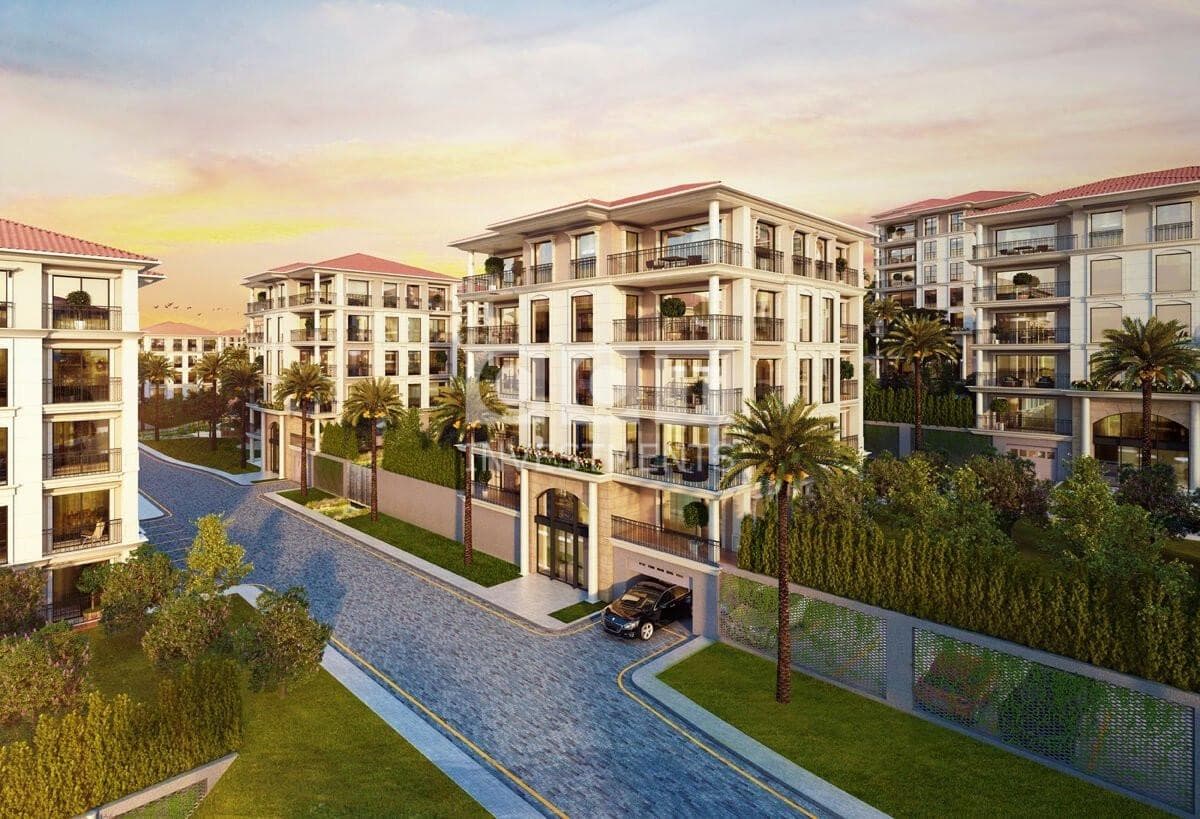
Before buying an apartment in Istanbul, check six things: how close it is to a metro or rail station and main roads, what the view is and whether it can be lost, whether the size suits your plans, whether to buy new-build or resale, off-plan or finished, how the building was designed for earthquakes, and whether your budget and expectations match the market. This checklist goes through each, with the costs and rules that apply to foreign buyers in 2026.
1. Is the Apartment Close to a Metro Line?
Istanbul has been expanding its rail network for two decades, and "metro everywhere" has been the city's slogan for much of that time. With its capacity and reliability, the metro is the fastest way across a city where road traffic is heavy, and it carries a large share of Istanbul's daily commuters.
Two lines that were still under construction when this guide was first written are now running:
- M7 Mecidiyeköy – Mahmutbey opened on 28 October 2020, linking the old business centre in Mecidiyeköy with the west of the city.
- M11 Gayrettepe – Istanbul Airport – Halkalı opened in stages from 2023 and was completed in June 2026, when the final section to Halkalı entered service. It connects the airport with Kağıthane, Göktürk, Kayaşehir and the Marmaray line at Halkalı.
Being within walking distance of a running station makes daily life easier and is one of the strongest supports for rent and resale demand. Buying near a line under construction can pay off when it opens, but lines are often delayed, so value what is running today. There is no fixed percentage by which a new station raises prices. Our guide to Istanbul's mega projects shows what is open and what is still planned.
2. Is the Apartment Close to Main Roads?
The metro is not the only factor. Many residents still depend on cars, and being close to a main road can make a big difference.
Istanbul's two main east–west roads are the D-100, still widely called the E-5, and the TEM motorway. The Basın Ekspres Road links the two, and the government turned the former industrial land along it into residential and business areas. It now has homes, offices, hotels, schools, universities, hospitals and shopping centres, and it is still developing. Further north, the Northern Marmara Motorway and the third Bosphorus bridge opened new areas such as Başakşehir and Arnavutköy.
See current projects in Basın Ekspres, Başakşehir and Halkalı.
3. What Is the View From the Apartment?
Istanbul lies on green hills between the Sea of Marmara and the Black Sea, with the Bosphorus running between them. Mosques, palaces and red-roofed buildings complete one of the world's great city views, and it is at its finest along the Bosphorus.
Roughly from most to least sought after, views in Istanbul rank like this: Bosphorus view, sea view, forest or nature view, landscaped garden view, city or road view.
- Bosphorus. The shores are protected by the Bosphorus Law (Law No. 2960), which limits new building and density, so homes on the water are mostly older, restored or rebuilt. A newer high-rise inland with a distant Bosphorus view is a way to combine a modern building with the view.
- Sea of Marmara. Istanbul has a long Marmara coastline, but most of it was built up decades ago, which leaves limited space for new projects close to the water. Near the centre, look at Zeytinburnu, Bakırköy, Kadıköy and Kartal; further out, Küçükçekmece, Avcılar, Beylikdüzü, Büyükçekmece and Pendik.
A clearer, closer view generally adds value, but check whether anything can be built in front of it. Our guide to sea view property in Istanbul covers what to check.
4. What Size of Apartment?
As Turkey's commercial capital, Istanbul has always drawn people from the rest of Turkey and from abroad. Together with incomes, transport and living costs, this has shaped a population in which young people and small families are a large group, and many of them prefer smaller, affordable homes close to work.
So when you choose, remember that smaller apartments usually find tenants and buyers more easily. Larger units suit families who will live in them. Also check how the size is measured: brochures often give the gross area, which includes shared spaces. See gross and net square meters. Net area also decides which VAT rate applies to a new home.
5. New-Build or Resale?
| New-build | Resale | |
|---|---|---|
| Earthquake design | Designed under the current code if the permit is recent | Depends on the building year; older buildings need checking |
| Condition | New fittings, better insulation, little renovation needed at first | May need renovation; ask what has been done |
| Facilities | Often in compounds with security, parking, pools and gyms | Often standalone buildings in established neighbourhoods |
| Running costs | Compound service charges can be significant | Usually lower service charges, higher repair risk |
| VAT | 1%, 10% or 20% may apply; foreign buyers can be exempt on a new home bought from the developer, under conditions | Usually no VAT when the seller is a private individual |
| Buying through CCT | No commission for buyers; the developer pays us | 2% + VAT brokerage |
| Payment | Developers often offer payment plans | Usually paid in full at the title deed transfer |
New buildings are built with better insulation and modern windows, which keep homes warmer in winter and cooler in summer and lower energy bills. They also need little work in the first years. Resale homes let you move in straight away, see exactly what you buy, and choose from central, established streets where new projects are rare.
When you buy new-build through us, project visits, title deed follow-up and after-sales support are free. See also properties with payment plans.
6. Off-Plan or Completed?
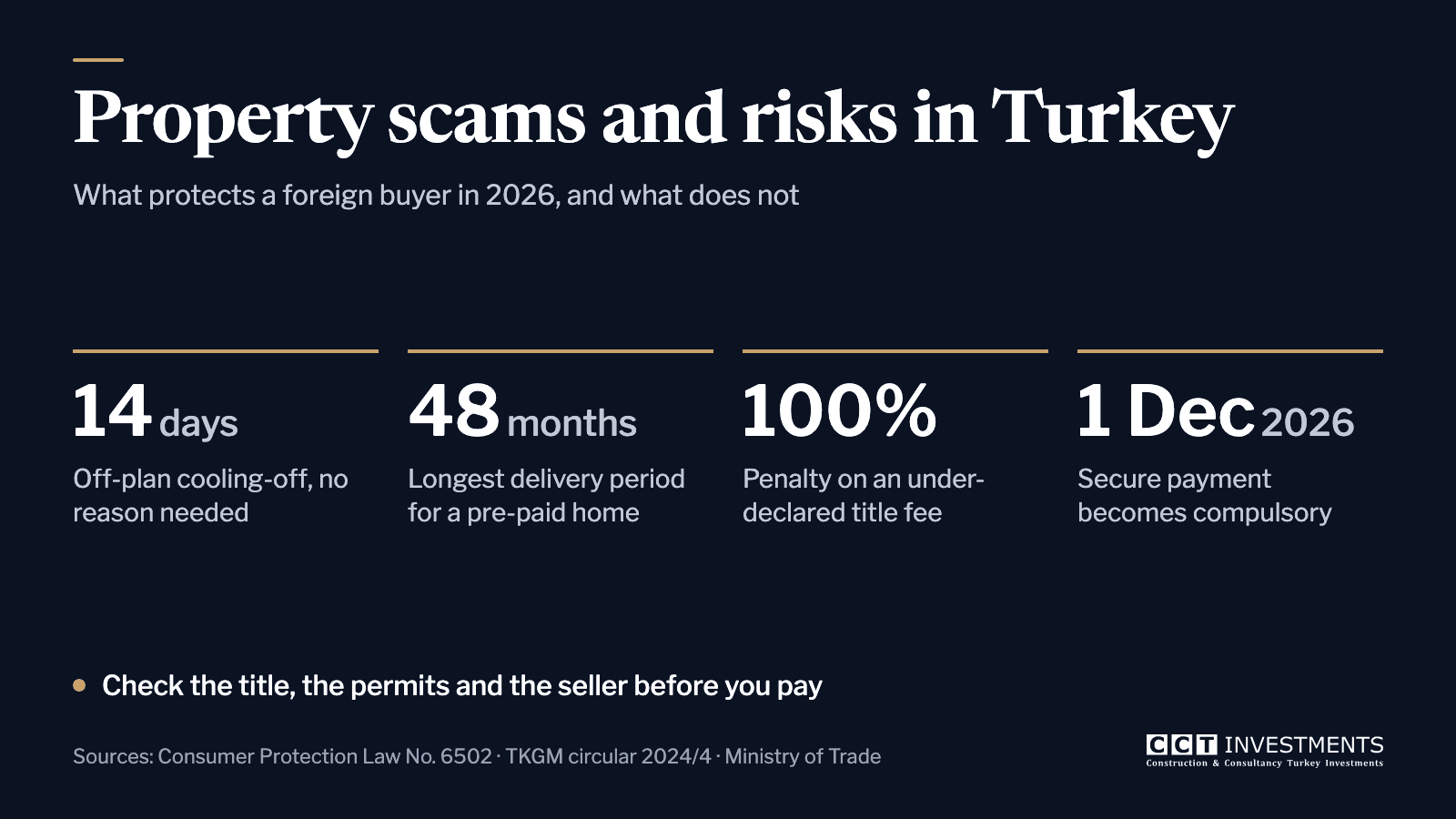
Buying off-plan can mean a lower price and a choice of units, but you take the risk that construction is delayed or, in the worst case, stopped.
Turkish consumer law regulates off-plan (pre-paid) home sales. The developer must have a building permit before selling, the contract must be notarised or registered at the land registry, and projects of 30 or more homes must provide a completion guarantee, such as building completion insurance or a bank guarantee.
To lower your risk:
- Deal with a developer with a record of finished, delivered projects. See top construction companies in Turkey.
- Buy at a later stage of construction if you want less risk.
- Check the permit, the title (a construction servitude, kat irtifakı, before completion) and the delivery date in the contract. On completion, the building gets an occupancy permit (iskan) and a condominium title. See iskan and kat mülkiyeti tapu.
7. Is the Building Safe in an Earthquake?
Since the 2023 earthquakes, buyers pay much more attention to how buildings were designed and built. Istanbul is in an earthquake zone, so this is a question for every apartment.
- Building year. In Istanbul, buildings with permits from 2001 onwards were supervised by licensed building inspection firms under Law No. 4708. The current Turkish Building Earthquake Code (TBDY 2018), published on 18 March 2018, has applied to new buildings since 1 January 2019.
- Older buildings. For a building from before 2000, ask for a structural assessment. Buildings found to be risky are covered by the urban renewal law (Law No. 6306), which can lead to demolition and rebuilding.
- Ground. Ask about the soil survey, especially near the shore.
- Insurance. Compulsory earthquake insurance (DASK) must be valid for the title deed transfer.
8. Do Your Expectations and Budget Match?
Realistic expectations are key to reaching your goal. Some buyers arrive hoping to buy the best property for less than the market price. It happens sometimes, but it is not the rule. A common mismatch: "I want a 4+1 apartment near Taksim Square with a small budget."
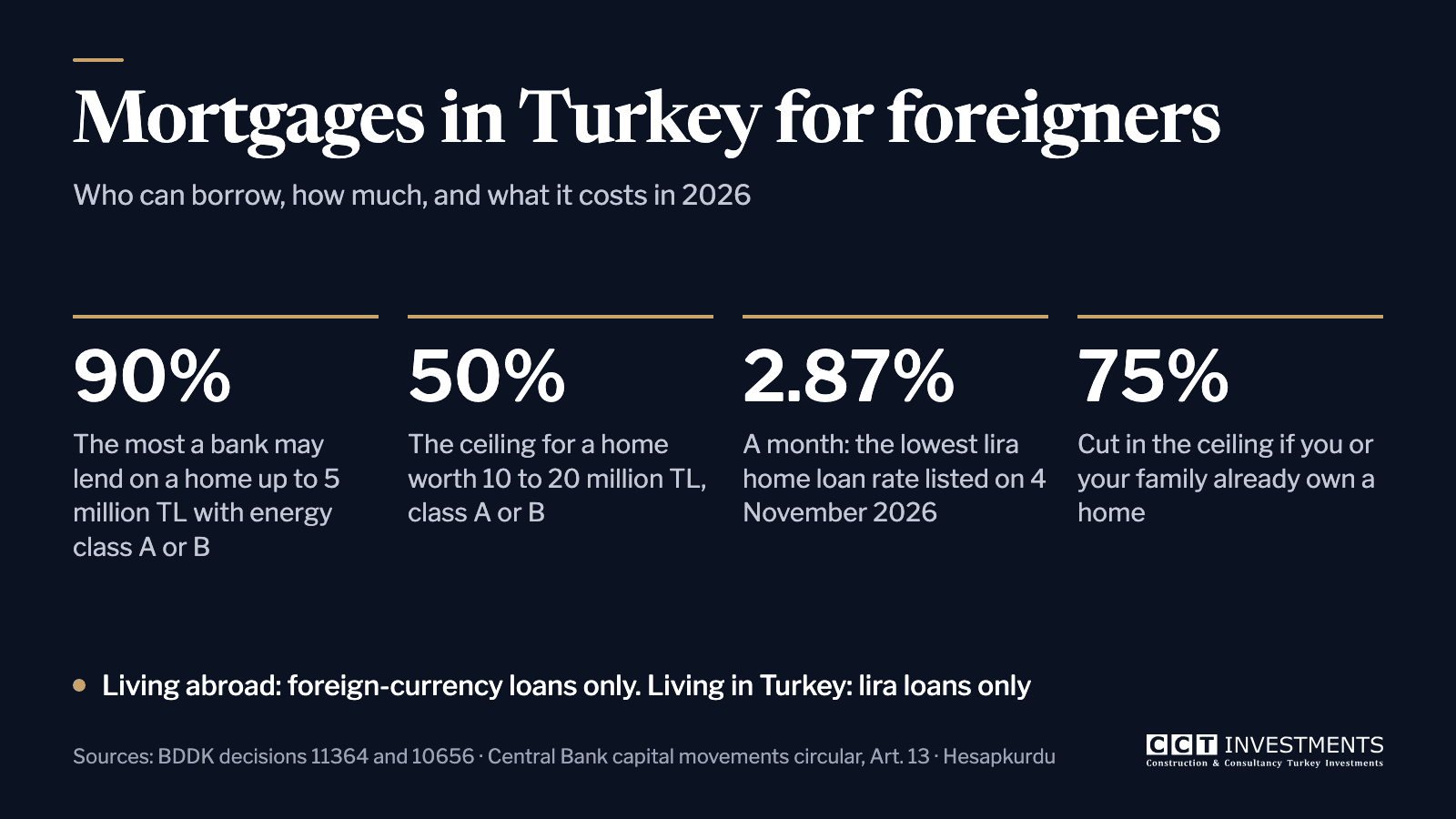
Look at what the market is doing. According to the Central Bank of the Republic of Turkey, house prices in July 2026 were up 25.0% in lira terms on a year earlier, but down 5.1% in real terms after inflation. Rents paid by new tenants rose 28.4% nationally and 32.4% in Istanbul. Returns vary by district, building and timing; no one can promise them.
Plan for the costs on top of the price:
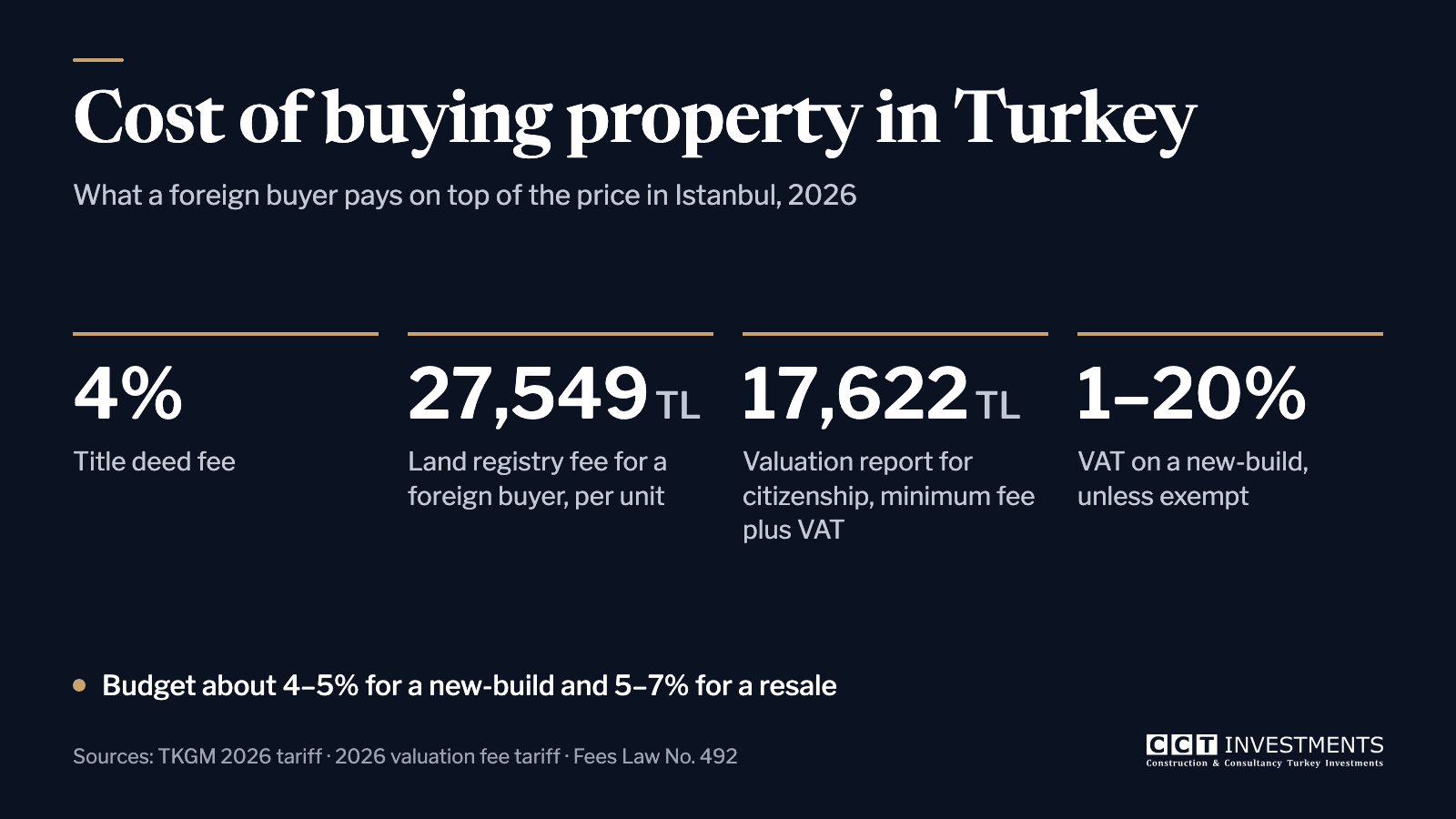
- Title deed fee: 4% of the declared price, usually 2% buyer and 2% seller.
- VAT on new homes, unless you qualify for the exemption. See VAT exemption for foreign buyers.
- Currency exchange document from a Turkish bank, required when a foreigner buys, and a valuation report by a licensed appraiser, required for a citizenship purchase. See the valuation report.
- Capital gains tax if you sell: homes bought from 1 January 2025 may be taxed at 15–40% on the inflation-indexed gain; homes bought before then are exempt after 5 years.
If you plan to apply for citizenship, the property must be worth at least USD 400,000 with a three-year no-sale annotation on the title deed. For a residence permit, the home must be worth at least USD 200,000 in Istanbul, and some neighbourhoods are closed to new permits. See citizenship by investment and which districts are open for residence permits.
Put It All Together
Whether you are an investor, moving to Istanbul, or buying a second home, the checklist is the same:
- Be close to a running metro station or a main road.
- Choose the view you want and make sure it will last.
- Pick the size that suits you; if you may sell within a few years, go smaller.
- Decide between new-build and resale with the earthquake design and running costs in mind.
- If you buy off-plan, check the developer, the permit and the completion guarantee.
- Match your budget to the market, and plan for the extra costs and taxes.
Read our buyer guide for the full process, browse all properties for sale in Istanbul, or contact us to discuss your budget.
Sources
- Central Bank of the Republic of Turkey (TCMB), House Price Index and New Tenant Rent Index (July 2026 release)
- Railway Gazette: Opening of final section completes Istanbul metro Line M11 (June 2026)
- M7 (Istanbul Metro), opening dates)
- Ministry of Trade: the Regulation on Pre-Paid Home Sales
- Resmî Gazete, Turkish Building Earthquake Code (TBDY 2018), 18 March 2018
- Law No. 4708 on Building Inspection (2001), Ministry of Environment, Urbanisation and Climate Change
- DASK, compulsory earthquake insurance, frequently asked questions